Same-Day Electrical Service Across Queens
Queens is the most diverse borough in the world — and AE Electric serves all of it. We provide same-day electrical service in Queens for homeowners, landlords, businesses, and property managers. From Astoria high-rises to the single-family homes of Forest Hills, our licensed electricians know Queens inside and out.
Queens also has the widest range of building types of any borough, and that changes the job more than the address does. A two-family house in Bayside with two meters, a Jackson Heights co-op, a Long Island City condo tower, and a bungalow in the Rockaways each have different service arrangements, different permit paths, and different failure modes. The sections below cover what work costs here, how two-family and converted spaces are handled, what the DOB requires, and what to expect in the flood-zone neighborhoods.
Call now: (646) 846-0008 — Same-day electrician service.
Electrical Services We Offer in Queens
- Emergency electrical repairs — same-day response for dead outlets, burning smells, sparking panels, and partial power loss
- Electrical panel upgrades — 100-amp, 150-amp, and 200-amp service, including Con Edison coordination
- EV charger installation — Level 2 charging in driveways, garages, and carports
- Wiring and rewiring — including knob-and-tube and aluminum wiring replacement
- Outlet, switch & GFCI installation — kitchens, bathrooms, basements, and exterior receptacles
- Lighting installation — recessed lighting, ceiling fans, LED retrofits, and exterior lighting
- Circuit additions — dedicated lines for appliances, basements, garages, and finished attics
- Standby generators — transfer switches and permitted installations
- Commercial electrical — retail strips, restaurants, and light industrial in LIC and Maspeth
- ECB violation removal — correcting and clearing open electrical violations
What Electrical Work Costs in Queens
Queens tends to be the most straightforward borough to work in. Driveways and side entrances mean crews can park and carry materials directly, and detached and semi-detached houses avoid the freight-elevator and building-hours constraints that slow apartment work down. The ranges below are typical market rates — we quote a flat rate for your specific job before work starts.
| Job Type | Typical Queens Cost Range |
|---|---|
| Outlet replacement (single) | $85 – $175 |
| GFCI outlet installation | $100 – $200 |
| Ceiling fan installation (existing wiring) | $150 – $300 |
| Recessed lighting (per can, existing wiring) | $100 – $200 |
| Circuit breaker replacement | $150 – $350 |
| New dedicated circuit | $200 – $500 |
| Electrical panel upgrade (100-amp) | $1,500 – $3,000 |
| Electrical panel upgrade (200-amp) | $2,500 – $5,000 |
| Level 2 EV charger installation | $500 – $1,500 |
| Whole-house rewire | $5,000 – $15,000+ |
| Emergency service call (after hours) | $150 – $300 service fee |
For a fuller breakdown, see our NYC electrician cost guide, panel upgrade cost guide, and rewiring cost guide.
Two-Family Homes, Basements, and Converted Spaces
Queens has more one- and two-family houses than any other borough, and a large share of them have been extended, subdivided, or converted at some point. That history is usually written into the electrical system.
- Two-family homes with multiple meters — Separate metering for each unit has to be arranged with Con Edison, and the split between house loads and unit loads needs to be correct. Common-area lighting, boilers, and exterior receptacles are frequently found wired to a tenant’s meter, which is worth correcting before it becomes a dispute.
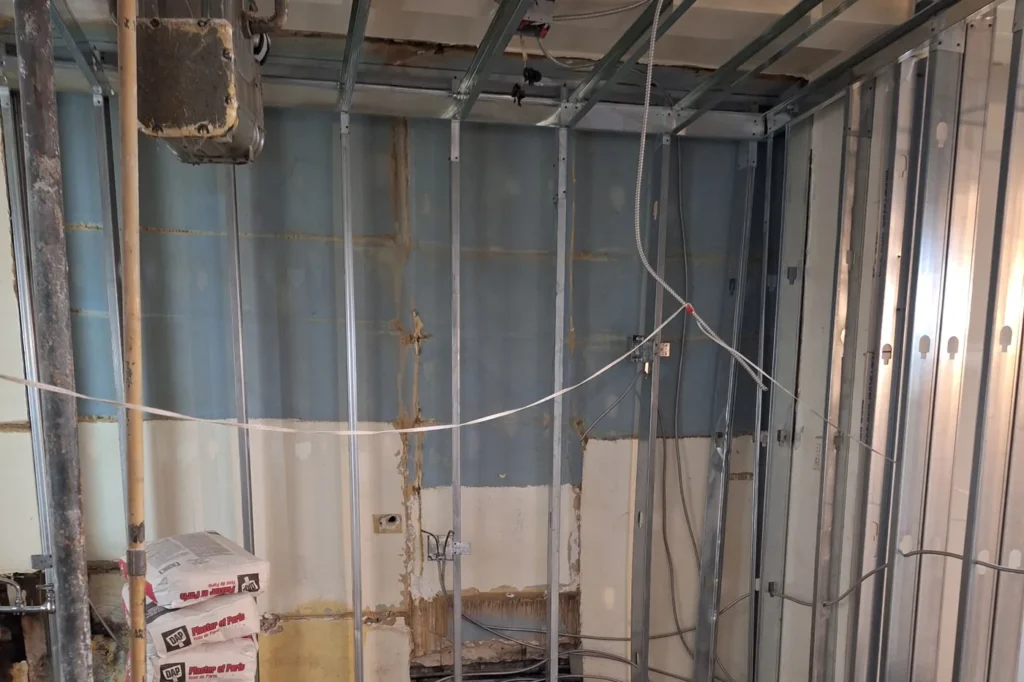
- Basement and attic conversions — Finished basements and attics are often wired by whoever did the renovation rather than by a licensed electrician. Undersized circuits, missing GFCI and AFCI protection, junction boxes buried behind drywall, and no permit record are the usual findings.
- Garage and driveway circuits — Detached garages need a properly sized feeder, a disconnect, and GFCI protection. This is also where most Queens EV charger installs land.
- Regularizing unpermitted work — If you are selling, refinancing, or bringing a unit into compliance, unpermitted electrical work will surface. We assess what is there, bring it to current NYC code, and file the permits so the record is clean.
We are happy to start with an electrical safety inspection so you know the scope before committing to a price.
EV Charging and the Queens Driveway Advantage
Queens homeowners have off-street parking at a far higher rate than Manhattan or Brooklyn, which makes Level 2 charging genuinely practical here rather than a building-wide negotiation. A typical install means a load calculation, a dedicated 240-volt circuit, a run to the driveway or garage, and a DOB permit.
Two things worth knowing before you buy a charger. First, most of Queens is fed from Con Edison’s underground network at 120/208 volts rather than the 120/240 volts common in suburban housing, so a Level 2 charger will deliver roughly 13% less power than its 240V rating suggests — it works, it is simply a little slower. Second, older houses on 100-amp service often need a panel upgrade to free up capacity for the charger. We run the load calculation first so you are not surprised. See our EV charger installation cost guide.
The Rockaways and Coastal Queens
Rockaway Beach, Far Rockaway, Broad Channel, and Howard Beach took the worst of Hurricane Sandy in 2012, and flood-zone electrical work here follows different rules than inland Queens. Panels, meters, and equipment in flood-prone properties should be mounted above the design flood elevation rather than in a basement that has already flooded once. Sump pumps belong on dedicated circuits, and standby generators need placement that accounts for both flooding and exhaust clearances.
If your home flooded and the electrical system was submerged, submerged panels and breakers should be replaced rather than dried out and reused — corrosion inside the equipment continues long after it looks fine. Our hurricane season electrical prep guide covers what to do before the next storm.
Permits, Con Edison, and the DOB Process
- Homeowners cannot pull their own electrical permit. NYC requires electrical filings be made by a licensed Master Electrician or Special Electrician. There is no homeowner self-permit option, even for a detached house you own outright.
- Filings go through DOB NOW: Electrical and appear on your property’s public DOB record.
- Electricians cannot self-certify the work. The DOB inspects before sign-off, so an offer to skip the permit is a red flag rather than a shortcut.
- Minor like-for-like swaps are the exception — a breaker rated 30 amps or under, or like-for-like panel parts at 150 volts or under, still require a licensed electrician but do not trigger a DOB inspection.
- Service upgrades involve Con Edison. Increasing service size or adding significant load may require a Con Edison service application, and their scheduling usually sets the timeline rather than the electrical work itself.
We file the permit, coordinate with Con Edison, and meet the inspector. See our NYC electrical permit guide and how long electrical work actually takes.
Landmarked Districts in Queens
Queens has several designated historic districts, including Jackson Heights, Sunnyside Gardens, Douglaston Hill, and the Stockholm Street district in Ridgewood. As elsewhere in the city, landmark status governs the exterior rather than your interior wiring — facade and stoop lighting, a relocated meter or service head, and surface-run conduit on a visible elevation generally need Landmarks Preservation Commission approval. Interior rewiring and panel work proceed on the normal DOB track.
Common Electrical Problems in Queens Homes
Queens has one of the most varied housing mixes in the city — high-rises in Long Island City, detached single-family homes in Howard Beach, and dense apartment blocks in Jackson Heights. Electrical problems vary by neighborhood and building type.
- Aging panels in single-family homes — Homes in Forest Hills, Bayside, and Kew Gardens built in the 1950s–70s frequently have 60-amp or 100-amp panels that can’t support modern appliances, central AC, or EV chargers. Panel upgrades are one of our most common Queens jobs. Our 100-amp vs 200-amp comparison explains what each level runs.
- Aluminum wiring in apartment buildings — Common in Flushing, Elmhurst, and Jackson Heights buildings from the 1960s–70s. Aluminum oxidizes at connection points and creates a fire hazard; we inspect and remediate these connections throughout Queens.
- Federal Pacific and Zinsco panels — Found in houses updated between the 1950s and 1980s. These have a documented history of breakers that fail to trip under fault. If your panel says Federal Pacific or Stab-Lok, read why it should be replaced.
- Unpermitted work in basement and garage conversions — Queens has a large number of converted spaces with unlicensed electrical work. If you’re selling or regularizing a unit, we bring the wiring to NYC code and file the permits.
- Breakers that trip repeatedly — Usually an overloaded circuit, sometimes a failing breaker, occasionally a ground fault in old wiring. See why breakers keep tripping.
- EV charger demand — Queens homeowners have private driveways at a much higher rate than in Manhattan or Brooklyn. Level 2 EV charger installation is one of our fastest-growing services in the borough.
Building Types We Work In
- Single-family homes and two-family houses
- Multi-family apartment buildings and garden apartment complexes
- Co-ops in Forest Hills, Rego Park, and Jackson Heights
- Commercial strips and retail spaces
- Industrial and light commercial properties in LIC and Maspeth
- New condo developments in Long Island City and Astoria
Queens Neighborhoods We Serve
We cover all of Queens, including Astoria, Long Island City, Sunnyside, Woodside, Jackson Heights, Elmhurst, Corona, Flushing, Whitestone, College Point, Bayside, Douglaston, Little Neck, Fresh Meadows, Jamaica, St. Albans, Hollis, Queens Village, Forest Hills, Rego Park, Kew Gardens, Richmond Hill, Ozone Park, Howard Beach, Broad Channel, Rockaway Beach, Far Rockaway, Ridgewood, Maspeth, Middle Village, Glendale, and Woodhaven.
Why AE Electric for Electrical Work Here?
- ✅ NYC DOB-licensed electrician
- ✅ Same-day service available
- ✅ Fully insured — liability and workers’ comp
- ✅ NYC code compliant — permits filed through DOB NOW when required
- ✅ Flat-rate pricing — no hourly surprises
Electrical Service in Other Boroughs
AE Electric serves all five boroughs: Manhattan, Brooklyn, the Bronx, and Staten Island. See all electrical services or read our electrical guides.
Trusted NYC Resources
- NYC Dept. of Buildings — Electrical Project Requirements & Inspections
- Con Edison — Electric Safety
- NYC DCWP — Verify a Licensed Contractor
Call for Same-Day Electrical Service Today
📞 Call or text: (646) 846-0008
🕐 Same-day availability, 7 days a week
📍 Serving all of Queens and the five boroughs
🔗 Get a free same-day estimate →
Frequently Asked Questions
Which Queens neighborhoods do you serve?
All of Queens — Astoria, Long Island City, Sunnyside, Woodside, Jackson Heights, Elmhurst, Corona, Flushing, Whitestone, College Point, Bayside, Douglaston, Little Neck, Fresh Meadows, Jamaica, St. Albans, Hollis, Queens Village, Forest Hills, Rego Park, Kew Gardens, Richmond Hill, Ozone Park, Howard Beach, Broad Channel, Rockaway Beach, Far Rockaway, Ridgewood, Maspeth, Middle Village, Glendale and Woodhaven.
How much does an electrician cost in Queens?
Typical ranges: $85–$175 to replace an outlet, $100–$200 for a GFCI, $150–$350 for a breaker replacement, $200–$500 for a new dedicated circuit, $1,500–$3,000 for a 100-amp panel upgrade and $2,500–$5,000 for 200 amps. Queens is often the most straightforward borough to work in — driveways and side entrances mean no freight elevator or building-hours constraints. We quote a flat rate before work starts.
Do you work on one- and two-family homes?
Yes. Queens has more of them than any other borough, and the common jobs are panel upgrades, EV charger installs, rewiring older homes, and adding circuits for basements, garages and finished attics. We also sort out two-family metering — house loads such as common lighting and boilers are often incorrectly wired to a tenant’s meter.
Can you install an EV charger at a Queens home?
Yes — Queens is one of the easiest boroughs for it, since driveways and garages make the install straightforward. We run the load calculation, pull the DOB permit, and install a Level 2 charger. Note that most of Queens is on Con Edison’s 120/208-volt network, so a Level 2 charger delivers about 13% less power than its 240V rating suggests. It works normally, just slightly slower.
My basement or attic was finished without permits. Can you fix that?
Yes, and it is common here. Converted spaces are often wired by whoever did the renovation rather than a licensed electrician — undersized circuits, missing GFCI and AFCI protection, junction boxes buried behind drywall, and no permit record. We assess what is there, bring it to current NYC code, and file the permits so the record is clean before a sale or refinance.
Can I pull my own electrical permit in Queens?
No. New York City requires that electrical work be filed by a licensed Master Electrician or Special Electrician through DOB NOW: Electrical. There is no homeowner self-permit option, even for a detached house you own outright.
Do you work in the Rockaways and other flood-zone areas?
Yes. Flood-zone work follows different logic: panels, meters and equipment should be mounted above the design flood elevation rather than in a basement that has already flooded, sump pumps belong on dedicated circuits, and generators need placement that accounts for both flooding and exhaust clearances.
My home flooded. Can the panel be dried out and reused?
No. Submerged panels and breakers should be replaced rather than dried out and put back into service. Corrosion continues inside the equipment long after it looks and tests fine, and the failure comes later.
What should I do if I smell burning or see sparks from an outlet or panel?
Stop using the circuit and shut it off at the panel if you can do so safely. A burning smell, scorch marks or sparking at a panel is a fire risk, not a repair that can wait. Call us at (646) 846-0008 for same-day emergency service — and if there is smoke or active burning, call 911 first.
Do you offer same-day service in Queens?
Yes, typically, seven days a week. Call or text (646) 846-0008.