Standby & Portable Generator Installation Across All 5 Boroughs
AE Electric installs whole-house standby generators and automatic transfer switches throughout all five NYC boroughs, with same-day assessments available at (646) 846-0008. A standby generator installation in New York City typically costs $5,000–$15,000 for a natural gas or propane whole-house unit, or $500–$1,500 for a transfer switch on a portable generator. All installations include NYC DOB permits and Con Edison coordination where required.
Call now: (646) 846-0008 — Same-day generator assessments across NYC.
Types of Generator Installation We Do in NYC
| Type | Best For | Typical NYC Cost | Fuel |
|---|---|---|---|
| Whole-house standby | Brownstones, townhouses, small buildings | $5,000–$15,000 installed | Natural gas or propane |
| Transfer switch for portable | Apartments, co-ops, renters | $500–$1,500 installed | Portable generator (gas) |
| Partial-load standby | Critical circuits only — HVAC, fridge, medical | $3,000–$8,000 installed | Natural gas or propane |
Standby generator or portable generator with a transfer switch?
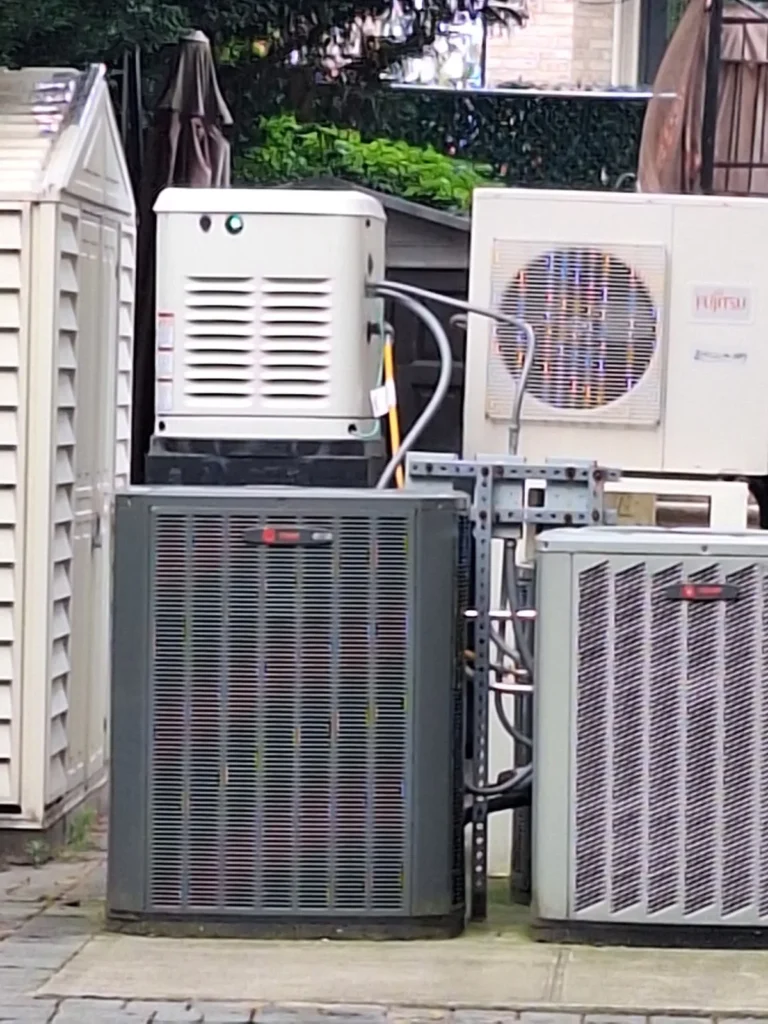
A standby generator is permanently installed, runs on natural gas or propane, and starts on its own through an automatic transfer switch when utility power drops. A portable generator is a cheaper starting point, but someone has to roll it out, fuel it, and start it, and it is only safe when it feeds the building through a properly installed transfer switch or inlet, never by plugging it into a wall outlet.
Never run a portable generator indoors, in a garage, or near a window or door. The exhaust contains carbon monoxide, which can build up to dangerous levels quickly. Our NYC smoke, CO and gas detector guide explains the alarms you should have in place either way.
Generator Brands We Install in NYC
- Generac — the most common whole-house standby brand in NYC; Guardian and PowerPact series for homes up to 3,000 sq ft
- Kohler — premium standby units with low noise output; preferred in co-ops with noise restrictions
- Cummins — commercial-grade residential units; ideal for larger brownstones and multi-family buildings
- Briggs & Stratton — mid-range standby option for smaller homes and condos
- Champion — portable generator transfer switch hookups for apartments and co-ops
Generator Sizing Guide for NYC Homes
| Generator Size | What It Powers | Best NYC Use Case |
|---|---|---|
| 7–10 kW | Essentials: lights, fridge, outlets, sump pump | 1–2 bedroom apartment or studio |
| 14–16 kW | Essentials + central AC or heat | Full brownstone floor or 3-BR apartment |
| 18–22 kW | Whole home: all circuits, HVAC, appliances | Full brownstone or townhouse |
| 22–30 kW+ | Whole home + EV charging or large HVAC | Large townhouse or small multi-family |
NYC Generator Installation Process
- Same-day assessment — AE Electric evaluates your electrical panel, available space, gas supply, and NYC zoning to determine the right unit and placement
- Permit filing — Generator installations in NYC require a DOB electrical permit; gas-connected units also require a DOB plumbing/gas permit. AE Electric handles both
- Automatic transfer switch installation — The ATS is wired between your utility feed and generator, switching power within seconds of an outage
- Generator placement & connection — Unit is placed on a concrete pad (or anti-vibration mounts for indoor installations), connected to the gas line, and wired to the transfer switch
- Load test & inspection — Generator is tested at full load, inspected by NYC DOB, and Con Edison is notified of the interconnection as required
NYC Generator Permit & Code Requirements
- NYC DOB Electrical Permit — Required for the automatic transfer switch and all wiring connections
- NYC DOB Gas Permit — Required for natural gas line connection to the generator
- Con Edison notification — Required for any generator connected to or near the utility grid
- Noise ordinance — Most NYC residential zones require generator units rated under 65 dB at 23 feet
- Flood zone placement — Generators in FEMA flood zones (coastal Brooklyn, Queens, Staten Island) must be elevated above base flood elevation
Generator installation by building type and borough
In New York City the building usually decides what is practical more than the borough does:
- Brownstones and townhouses — usually a backyard or side-yard pad. Available space, clearances, and the existing electrical service determine the unit size. Our brownstone electrical upgrades guide covers the service side.
- Co-ops and condos — a generator generally needs board or managing-agent approval, and noise limits can narrow the options. A transfer switch for a portable unit is sometimes the practical answer. See our co-op and condo electrical guide.
- Flood-zone and coastal properties — placement above flood elevation matters; see the permit and code requirements above.
We install generators in all five boroughs: Brooklyn (including Williamsburg), Manhattan (including Midtown), Queens, the Bronx, and Staten Island.
Licensed NYC Generator Installation Contractor
- ✅ NYC DOB-licensed electrical contractor
- ✅ NYC DOB permitted work — electrical and gas permits handled
- ✅ Con Edison coordination included
- ✅ Fully insured — general liability + workers’ compensation
- ✅ Same-day assessments across all 5 boroughs
- ✅ Flat-rate pricing — no hourly surprises
Related Services
- Electrical Panel Upgrade NYC — Many generators require 200-amp service; AE Electric can upgrade your panel as part of the same project
- Whole House Surge Protection NYC — Protects appliances from voltage spikes when generator switches on and off
- Electrical Safety Inspection NYC — Recommended before generator installation to identify any wiring issues under generator load
- EV Charger Installation NYC — If sizing up for a generator, adding an EV circuit at the same time saves significant cost
- Backup Generator Installation Cost in NYC — A detailed look at what drives the price
- NYC Electrical Permit Guide — How electrical permits and filings work
- Hurricane Electrical Prep — What to do before a storm and after an outage
Get a Same-Day Generator Assessment in NYC
Call or text (646) 846-0008 for a same-day generator installation assessment anywhere in NYC. AE Electric serves Manhattan, Brooklyn, Queens, the Bronx, and Staten Island — 7 days a week.
📞 (646) 846-0008 — Available 7 days a week
🔗 Request a free estimate online →
Related reading: For heating-season outages, see winter outages and generator safety.
Frequently Asked Questions
Do I need a permit for a standby generator in NYC?
Yes. The transfer switch and wiring require a DOB electrical permit, and depending on the fuel type and placement there may be additional DOB or FDNY requirements. We handle the filings.
What size generator do I need?
It depends on what you want to keep running. An essentials setup (refrigerator, heat, sump pump, some lights and outlets) is far smaller than a whole-home system. We run a load calculation and size the unit to what you actually need.
What is a transfer switch, and do I really need one?
Yes, and it is required. A transfer switch disconnects your home from the utility before the generator energizes your circuits. Without one, power can backfeed into the grid and kill a Con Edison lineman. It is not optional.
Can a generator go in a Brooklyn backyard or on a rooftop?
Often, yes. Placement is governed by code and manufacturer clearances — distance from windows, doors and property lines, plus fuel supply and exhaust. We assess the site before quoting.
Who installs a whole-house generator in NYC?
The electrical side, meaning the automatic transfer switch, wiring, and the DOB electrical permit, is done by a licensed electrician such as AE Electric. A gas-fired unit also involves a gas connection and gas permit, which we coordinate at the site assessment.
How much does generator installation cost in NYC?
Typically $5,000–$15,000 installed for a whole-house natural gas or propane unit, $3,000–$8,000 for a partial-load system covering critical circuits, and $500–$1,500 for a transfer switch for a portable generator. The final price depends on the unit size, site, and permits.
Can I install a generator in a co-op or condo?
Often, but it usually needs board or managing-agent approval, and noise limits and placement rules can restrict the options. For many apartments a transfer switch for a portable generator is the practical choice. Check with your building before ordering equipment.
Will I need an electrical panel upgrade for a generator?
Often. Many whole-house generators call for 200-amp service, so we check your panel and capacity at the assessment and can upgrade the panel as part of the same project.