
Hurricane Sandy made landfall on October 29, 2012, and the lights didn’t come back on for weeks in some of New York City’s most vulnerable neighborhoods. In Brooklyn alone, communities like Coney Island, Sea Gate, Manhattan Beach, Brighton Beach, Sheepshead Bay, Gerritsen Beach, Red Hook, and Carroll Gardens suffered catastrophic flooding, downed power lines, and electrical damage that left residents without power for 7–14 days. Sandy was not the last storm to hit NYC, and it will not be the last.
If you own a brownstone, townhouse, or home anywhere in New York City, a backup generator is no longer a luxury — it’s a practical investment. Here’s what installation actually involves, what it costs, and why AE Electric recommends it to every NYC homeowner we work with.
What Sandy Did to Brooklyn (And Why It Can Happen Again)
When Sandy struck, the NYC neighborhoods that suffered the most prolonged power outages were concentrated in low-lying coastal areas of Brooklyn and lower Manhattan:
- Sea Gate (Coney Island peninsula) — A gated community at the western tip of Coney Island, Sea Gate experienced near-total flooding. Homes were submerged, electrical panels destroyed, and many residents went without power for over two weeks
- Manhattan Beach — This quiet Brooklyn neighborhood between Sheepshead Bay and the Atlantic Ocean saw severe flooding and electrical infrastructure damage. Homeowners who had generators were able to maintain heat, refrigeration, and communication while neighbors waited for Con Edison crews
- Coney Island — The amusement district and surrounding residential blocks were extensively flooded; the subway station sat underwater for days
- Brighton Beach & Sheepshead Bay — Storm surge swept through both neighborhoods, flooding basements and ground floors and leaving thousands without power
- Gerritsen Beach — One of the most isolated neighborhoods in Brooklyn, Gerritsen Beach residents were cut off, with power outages lasting over a week in many blocks
- Red Hook — Despite being inland, Red Hook’s below-grade streets turned into rivers; the neighborhood became a defining image of Sandy’s destruction in Brooklyn
Lower Manhattan — particularly the Financial District, Battery Park City, and the area around the World Trade Center — also lost power for days. Con Edison’s flood-damaged transformer vault on East 13th Street caused an explosion that cut power to 250,000 customers across lower Manhattan, parts of Brooklyn, and Queens.
Why NYC Homeowners Need a Backup Generator
Beyond hurricanes, NYC power outages happen for many reasons: heat waves that overload the grid, nor’easters that knock down utility lines, and Con Edison infrastructure failures. Extended outages create real risks:
- Food spoilage — A full refrigerator loses safe temperature within 4 hours of a power loss; a freezer holds 24–48 hours
- Sump pump failure — Many NYC basements need continuous sump pump operation during storms; without power, flooding follows within hours
- Medical equipment — CPAP machines, nebulizers, oxygen concentrators, and refrigerated medications require uninterrupted power
- Heating and cooling — NYC summer heat waves and winter storms become dangerous when HVAC systems go offline
- Security systems — Most NYC home alarm and camera systems go down without power backup
Types of Backup Generators for NYC Homes
Not every NYC property uses the same generator solution. There are three main types:
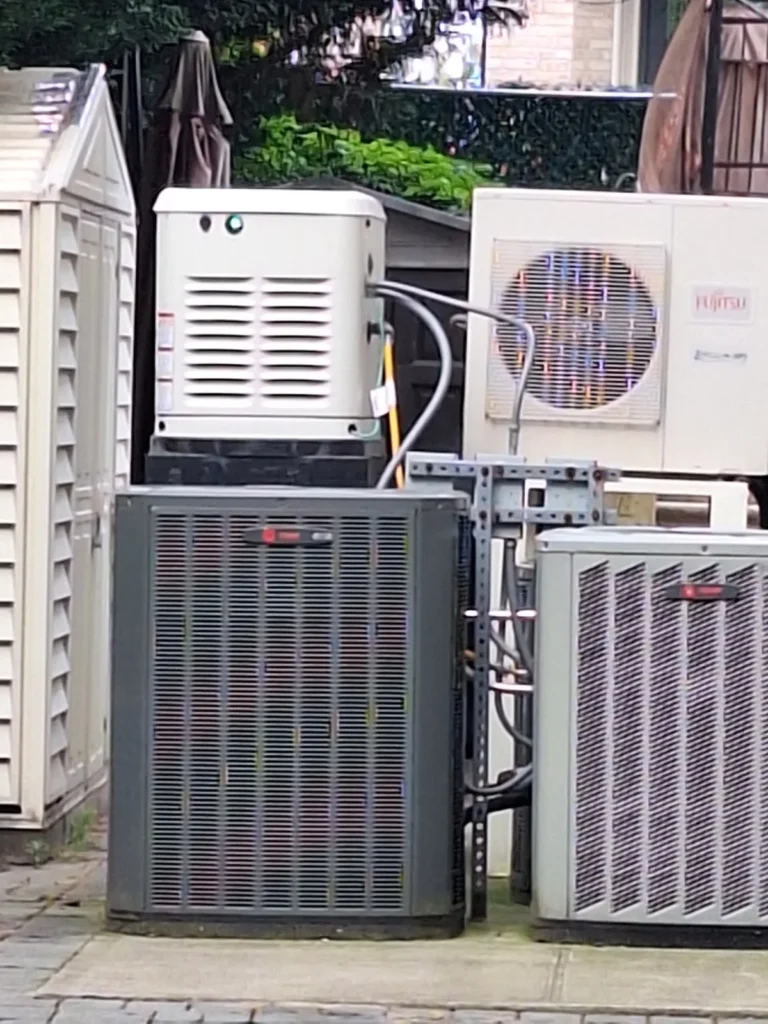
- Whole-house standby generator — Permanently installed, connects to your home’s natural gas line, and starts automatically within 10–30 seconds of detecting a power outage. No action required from the homeowner. This is the best option for brownstones, townhouses, and homes in flood-prone neighborhoods like Manhattan Beach, Sea Gate, and Sheepshead Bay
- Partial-load standby generator — Same automatic-start technology, but powers only critical circuits: refrigerator, sump pump, heat, selected outlets. Lower cost than whole-house coverage and often the right choice for larger brownstones where running everything on generator is impractical
- Transfer switch for a portable generator — A licensed electrician installs an automatic or manual transfer switch that lets you safely connect a portable generator to your home’s circuits. Lower upfront cost, but requires you to fuel and start the portable unit yourself — not ideal when a storm hits
What Does Generator Installation Actually Involve?
A whole-house generator installation is a multi-trade project that involves electrical and gas work. Here’s what it takes:
- Site assessment — An electrician evaluates your panel size (200-amp service is typically required for whole-house generators), available space for the unit and concrete pad, gas line capacity, and NYC noise/zoning requirements
- Generator sizing — Based on your home’s electrical load, a generator size (in kilowatts) is specified. Most NYC brownstones need 18–22 kW for whole-home coverage
- Permit filing — NYC requires both a DOB electrical permit and a DOB plumbing/gas permit for standby generator installation. Con Edison must also be notified. A licensed electrician handles all of this
- Automatic transfer switch installation — The ATS is wired between your utility feed and generator. When Con Edison power goes out, the ATS switches to generator power within seconds — automatically
- Concrete pad placement & unit installation — The generator sits on a concrete pad (or anti-vibration mounts for rooftop or indoor placement in NYC buildings) and is connected to the gas line and transfer switch
- Load test & DOB inspection — The generator is tested at full electrical load, then inspected by NYC DOB. After passing, the system is commissioned and ready to operate
How Much Does Generator Installation Cost in NYC?
| Generator Type | Equipment Cost | Installation Labor | NYC Permits | Total Estimate |
|---|---|---|---|---|
| Transfer switch (portable generator hookup) | $300–$800 | $400–$700 | $200–$400 | $500–$1,500 |
| Partial-load standby (7–14 kW) | $2,000–$4,000 | $1,500–$3,000 | $400–$800 | $3,000–$8,000 |
| Whole-house standby (18–22 kW) | $4,000–$8,000 | $2,500–$5,000 | $500–$1,000 | $7,000–$15,000 |
These are estimates for NYC installations. Final cost depends on panel readiness, gas line distance, unit brand and size, and any concrete work or structural modifications required. AE Electric provides flat-rate quotes after a same-day site assessment.
AE Electric Installs Generators in Manhattan Beach, Sea Gate, and Across Brooklyn
AE Electric has installed backup generators in some of the Brooklyn neighborhoods hardest hit by Hurricane Sandy, including Manhattan Beach and Sea Gate. We understand the specific challenges of coastal Brooklyn properties: flood zone generator placement requirements (units must be elevated above base flood elevation in FEMA flood zones), older brownstone panels that may need upgrading before a generator can be added, and the importance of getting the installation done right before the next storm arrives.
We serve all five NYC boroughs — Brooklyn, Manhattan, Queens, the Bronx, and Staten Island — and offer same-day generator assessments. Call or text (646) 846-0008 to schedule yours.
Don’t Wait for the Next Sandy
FEMA and NYC emergency management officials have been clear since 2012: New York City will face storms of Sandy’s magnitude again — and more frequently as climate patterns shift. The homeowners who fared best during Sandy were those who had generators already installed. They had lights, heat, refrigerators, and working sump pumps while their neighbors waited two weeks for Con Edison crews to restore the grid.
If you live in a coastal Brooklyn neighborhood, a basement-level Manhattan apartment, or anywhere you’ve experienced outages before, the time to install a backup generator is now — not when the storm is 48 hours away and every generator in a 50-mile radius is sold out.
Learn more about our NYC generator installation services → or call (646) 846-0008 for a same-day assessment.
Related reading: See winter outages and generator safety.