
“How long will this take?” is the second question every customer asks, and it is the one most often answered badly. The honest answer has two numbers in it, not one: how many days an electrician is actually in your apartment, and how many weeks pass between the first phone call and a signed-off job. In New York City those two numbers are rarely close together.
A panel upgrade is roughly a day of work. It is also, commonly, a six-week project. Nothing about that gap is the wiring. It is the Department of Buildings queue, Con Edison’s schedule, and — if you live in a co-op or condo — a board that meets once a month. Here is what each type of electrical job really takes in NYC, what sets the calendar, and how to keep your own project from stalling.
The two numbers: days on site vs. weeks on the calendar
Every quote you get is quietly answering one of two different questions. “Two days” usually means labor. “Six weeks” usually means the calendar. Both can be true of the same job, and the confusion between them is why people think their electrician has disappeared when in fact the file is sitting at the DOB.
That diagram is a real shape, not a worst case. On a permitted job, the work itself is usually the shortest phase. The permit has to be filed and issued before a licensed electrician can legally start; the inspection and sign-off happen after the work is finished. Anything involving the service, the meter, or more amps at the riser adds Con Edison, whose calendar no contractor controls.
So when you compare estimates, ask both questions out loud: how many days will you be here, and how many weeks until this is signed off? A contractor who only answers the first one is not necessarily hiding anything — but you are about to plan your kitchen around the wrong number.
How long each electrical job takes in NYC
These are typical ranges for residential work across the five boroughs, based on how these jobs actually run in pre-war apartments, brownstones, and one- and two-family houses. Elapsed time assumes a straightforward filing and no board involvement; add the co-op and condo review on top of it.
| Job | Time on site | Start to sign-off | DOB permit |
|---|---|---|---|
| Outlet, switch, or fixture replacement | 1–2 hours | Same day | No |
| GFCI outlet installation | 1–2 hours | Same day | Usually no |
| Troubleshooting a dead circuit or a repeat trip | 1–3 hours | Same day | No |
| Ceiling fan on an existing fan-rated box | 2–3 hours | Same day | No |
| Ceiling fan needing a new box and wiring | 4–6 hours | 1–3 days | Sometimes |
| New dedicated circuit | 4–8 hours | 2–5 weeks | Yes |
| Recessed lighting, one room | 1–2 days | 2–5 weeks | Usually |
| Level 2 EV charger | 1 day | 3–8 weeks | Yes |
| Panel replacement, same amperage | 1 day | 3–6 weeks | Yes |
| Service upgrade to 200 amps | 1–2 days | 4–10 weeks | Yes, plus Con Edison |
| Rewiring a 1–2 bedroom apartment | 3–7 days | 4–10 weeks | Yes |
| Rewiring a whole brownstone or house | 2–4 weeks | 2–4 months | Yes |
| Standby generator installation | 2–3 days | 6–12 weeks | Yes, plus utility and gas |
Same-day work: one visit, no permit
Most of what we do in a given week is finished in a single visit. Replacing a device or a fixture, adding a GFCI where the code asks for one, tracing a dead outlet, swapping a bad breaker — none of that requires a filing, a board, or the utility, so the only scheduling constraint is when someone can get to you. That is the work an emergency electrician in NYC handles the same day, and it is why a burning smell or a dead circuit should never wait weeks.
One or two days on site, but weeks on the calendar
This is the category people misjudge most. A new dedicated circuit, a Level 2 EV charger, a panel replacement, a room of recessed lighting: each is a day or so of labor, and each is permitted work. The filing goes in before anyone picks up a tool, and the job is not finished when the crew leaves — it is finished when the inspector signs off.
- Before the work: the site visit, a load calculation where one is needed, the DOB filing, and the permit coming back.
- The work itself: usually one or two days, sometimes split across two visits when the utility has to disconnect and reconnect.
- After the work: the inspection, then the sign-off that closes the permit. Skipping this is how a finished job turns into a violation on the property years later.
Multi-day projects: rewires and service upgrades
A full rewire is the one job where the labor genuinely is the long part. In a one- or two-bedroom apartment, expect the crew in the space for most of a week. In a three- or four-story brownstone with plaster walls and old knob and tube wiring to remove, two to four weeks of work is normal, and it is usually phased floor by floor so the building stays livable.
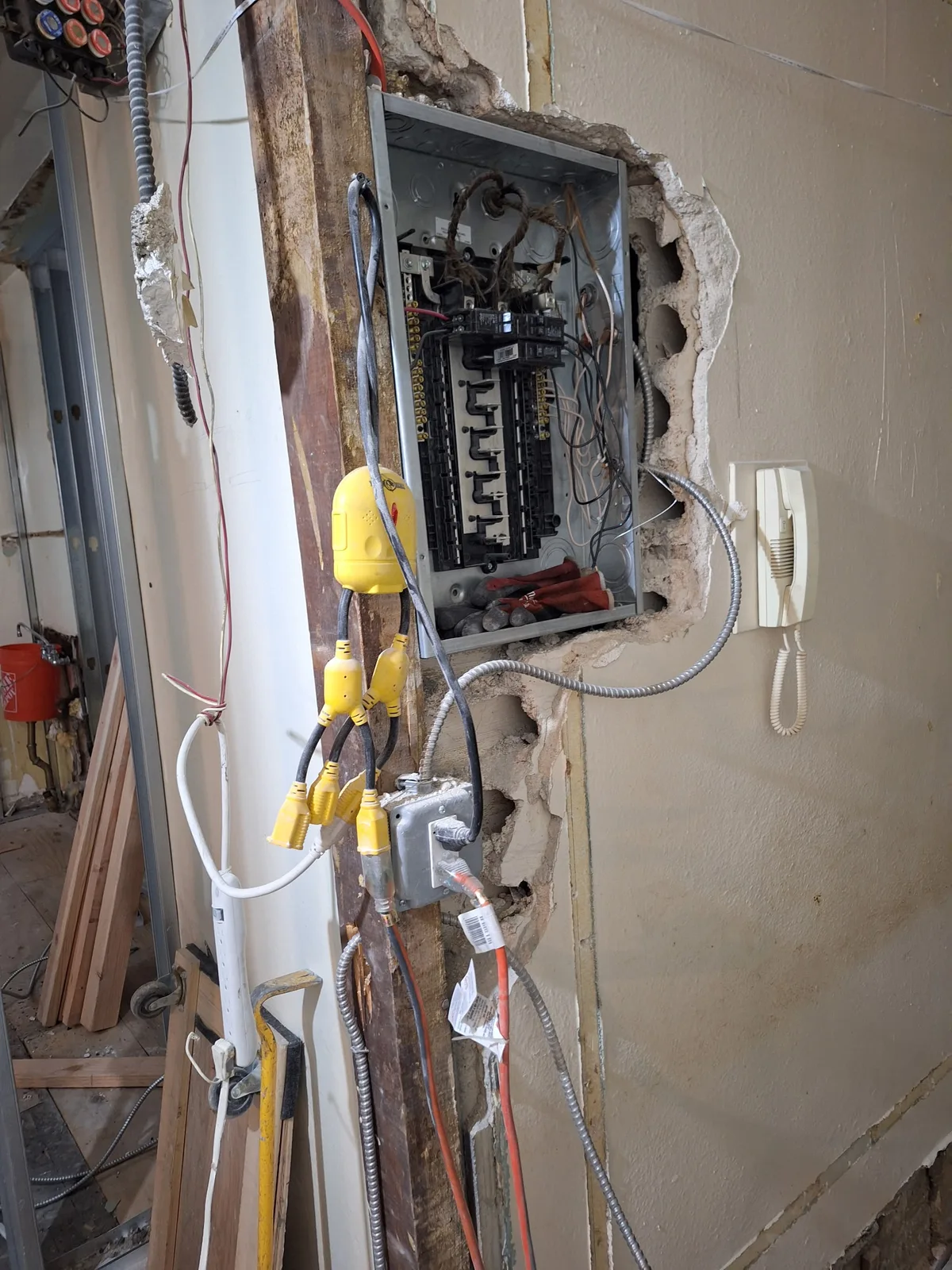
Two things stretch a rewire more than anything else: the condition of what is already in the walls, and access. A house where the walls are open for a renovation moves fast. An occupied apartment where every cable has to be fished behind finished plaster, on a schedule the building sets, does not.
Four questions that decide your timeline
Before anyone can give you a date, four things have to be answered. They are the difference between a job that happens on Thursday and the same job happening in November.
The permit question is the first one, and the answer is more predictable than people expect: new circuits, new panels, service changes, and rewires are filed work; a like-for-like replacement generally is not. Our guide to when you need an electrical permit in NYC covers where that line falls.
The board question is the one that surprises new owners. In a co-op or condo, the alteration agreement, the insurance certificates naming the building and the managing agent, and the board’s review all come before the permit — and boards typically meet monthly. Missing a meeting by three days can cost you four weeks. That sequence is laid out in our guide to what needs board approval in a NYC co-op or condo.
The Con Edison question is the one nobody can compress. If your job changes the service, the meter, or the amperage at the riser, the utility has to schedule its part, and that appointment sets the date for everything else. It is the main reason a 200-amp service upgrade runs long even when the electrical work itself is a single day.
What actually delays NYC electrical jobs
Beyond those four structural questions, here is what pushes real projects past their estimate — in rough order of how often we see it:
- Unpermitted work found on site. Someone’s cousin ran a circuit in 2009. It has to be corrected and folded into the filing, and if it has already produced an ECB violation, that gets resolved before anything closes out.
- Building access rules. Freight elevator hours, no work before 9 or after 4, nothing on Fridays, nothing during the week of a shareholder meeting. In many buildings this alone doubles a rewire’s calendar.
- Con Edison appointments. Scheduled, then rescheduled. Always the long pole on service work.
- What the walls are made of. Pre-war plaster and lath, brick party walls, and steel framing all slow cable runs down. So does asbestos or lead paint, which brings in a separate abatement trade before anything can be opened.
- Landmark and historic district review. Anything visible on a facade — a meter, a service mast, an outdoor fixture — can pull in the Landmarks Preservation Commission.
- Change orders. Every “while you’re here, could we also…” is a fair question, and every one of them is real time.
- Scheduling the inspection. The work is done, the apartment is put back together, and the sign-off still needs a date on someone else’s calendar.
How to make your electrical project go faster
Most of the calendar is outside your control. These are the parts that are not:
- Start the board package the day you decide, not the day you hire. In a co-op or condo this is the single biggest lever you have. The alteration agreement can be in motion while you are still collecting estimates.
- Hire a licensed master electrician who files their own permits. Anyone who tells you a panel or a new circuit does not need a filing is telling you they intend to skip it — which is fast right up until you sell.
- Decide everything before the filing. Fixture locations, outlet counts, whether the EV charger goes in now or later. Changes after the permit is issued can mean an amended filing.
- Bundle the work. If the walls are opening anyway, add the circuits you will want in five years now. One permit, one mobilization, one patch-and-paint.
- Book Con Edison’s piece early. On service work the utility appointment usually determines the date of everything else, so it should be requested as soon as the scope is fixed.
- Give real access. Keys, elevator reservations, a contact who answers the phone. Half of the “lost” days on NYC jobs are a crew standing in a lobby.
- Do not let the sign-off drift. An open permit on your address is a problem for the next buyer, the next appraiser, and the next electrical safety inspection.
A realistic timeline for your job, before you commit
AE Electric works in apartments, brownstones, and houses across Manhattan, Brooklyn, Queens, the Bronx, and Staten Island. We quote both numbers — days on site and weeks to sign-off — after we have seen the panel and asked about your building, because a timeline given over the phone without either of those is a guess. We file the permits, coordinate with Con Edison and your managing agent, and close the job out with the inspection rather than leaving it open.
For the money side of the same planning, see our NYC electrician cost guide. For a date, call (646) 846-0008 or request an estimate and tell us what you need finished, and by when.
Frequently Asked Questions
How long does an electrical panel upgrade take in NYC?
The work itself is usually one day, or two if the service is being changed. The calendar is longer: expect roughly 3 to 6 weeks from the first visit to a signed-off permit for a like-for-like panel replacement, and 4 to 10 weeks for a 200-amp service upgrade, because Con Edison has to schedule its part.
How long does it take to rewire an apartment or house in NYC?
A one- or two-bedroom apartment is typically 3 to 7 days of crew time and 4 to 10 weeks start to sign-off. A full brownstone or house is 2 to 4 weeks of work and 2 to 4 months overall, usually phased floor by floor so the building stays livable.
How long does a DOB electrical permit take in New York City?
For straightforward residential work filed by a licensed master electrician, the permit generally comes back within 1 to 3 weeks. The inspection and sign-off after the work is finished add another 1 to 3 weeks. Both windows are part of your real timeline.
Can an electrician do the work the same day in NYC?
Yes, for anything that does not need a filing: replacing outlets, switches, and fixtures, adding a GFCI, swapping a breaker, or tracing a dead circuit. Same-day service is standard for that work, and for genuine emergencies it should never wait.
How long does co-op or condo board approval take for electrical work?
Typically 2 to 8 weeks. The driver is the board meeting schedule rather than the review itself, so submitting a complete alteration package right after a meeting can cost you a month. Board approval comes before the DOB filing, not alongside it.
Why do two electricians quote completely different timelines for the same job?
Usually because one is quoting days on site and the other is quoting calendar time to sign-off. Both can be honest. Ask each of them for both numbers, and ask specifically whether the estimate includes the permit, the Con Edison appointment, and the final inspection.