

How to Tell Your NYC Home Has Outgrown Its Electrical Panel
Your electrical panel is the heart of your home’s electrical system. In New York City, where most housing was built before flat-screen TVs, air fryers, and EV chargers existed, that panel is often running close to its limit. Here is how to tell whether your NYC apartment or house needs an electrical panel upgrade before it becomes an emergency.
Sign 1: Your circuit breakers trip frequently
If you’re resetting breakers more than once a month, especially the same one, your panel is telling you something. Frequent tripping usually means a circuit is overloaded, and sometimes that the whole service is too small for how you live now.
Not every trip means the panel is the problem. A single breaker that trips only when you run the microwave and toaster together points to one overloaded circuit, which may need a dedicated circuit rather than a new panel. Several breakers tripping, or a main breaker that trips, points at the service. Our guide on why a breaker keeps tripping shows how to tell the difference.
Sign 2: You still have a fuse box
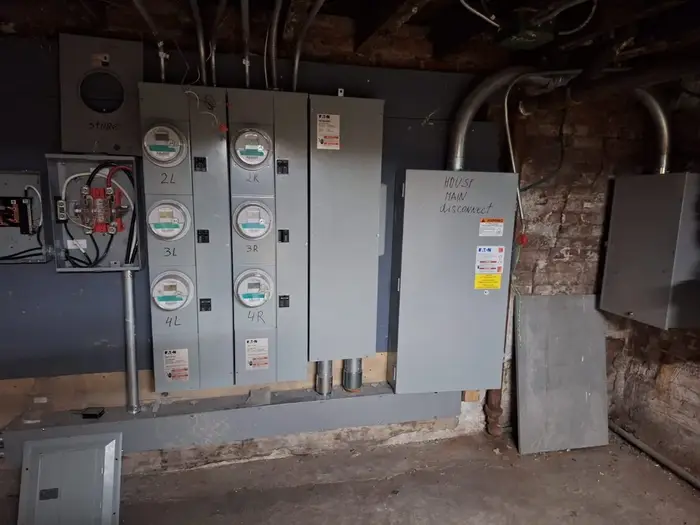
If you open the panel door and see glass or ceramic fuses instead of breaker switches, you’re working with equipment from the 1950s or earlier. Fuse boxes were designed when a single 60-amp service was plenty for a household.
Beyond being undersized, fuse boxes invite a dangerous habit: replacing a blown fuse with a higher-rated one, which defeats the protection. Many insurers will no longer cover a home with an active fuse box. We explain the differences in fuse box vs circuit breaker.
Sign 3: Lights flicker or dim when you use appliances
When you start the microwave and the kitchen lights dim, high-draw appliances are pulling enough current to starve other circuits. Occasional dimming when an air conditioner compressor starts can be normal. Flickering that happens with ordinary loads, or lights that surge brighter and dimmer, can also mean a loose connection at the panel or meter, which is a safety issue and not just a capacity one.
Sign 4: You’re adding a major appliance or an EV charger
Planning in-unit laundry, an electric dryer, an induction range, central air or heat pumps, or a Level 2 EV charger? Each adds a large dedicated load. Typical circuit sizes:
| Load | Typical circuit |
|---|---|
| Level 2 EV charger | 40 A, 240 V (for a 32 A charger) |
| Electric dryer | 30 A, 240 V |
| Electric range or induction cooktop | 40–50 A, 240 V |
| Central AC or heat pump | 20–50 A, 240 V |
| In-unit washer | 20 A, 120 V |
On a 100-amp service, the EV charger plus a dryer plus an induction range can exceed what the service can safely supply. A load calculation by a licensed electrician tells you whether you need an upgrade first. Our post on 100-amp vs 200-amp service explains how that decision is made.
Sign 5: Your inspector or insurer flagged the panel
If a home inspector flagged your panel, especially if it is a Federal Pacific (Stab-Lok) or Zinsco brand, take it seriously. Both have a documented history of breakers that fail to trip under overload, which means the fire protection they are supposed to provide doesn’t work reliably. Read more in our posts on Federal Pacific panels and Zinsco panels.
If your insurer is threatening to drop coverage or raise your rate because of your panel, that isn’t an upsell. It’s a real risk they have priced in.
Other warning signs worth acting on
- A burning or hot-plastic smell near the panel or an outlet
- A panel cover that feels warm, or visible scorch marks and discoloration
- Buzzing, crackling, or humming from the panel
- Breakers that feel loose or won’t stay on
- Two-prong outlets and extension cords or power strips running to every room, a sign there aren’t enough circuits
- No open breaker spaces left for new circuits
A burning smell, scorching, or a hot panel is not a wait-and-see situation. Turn off what you can safely turn off and call us; see what counts as an electrical emergency.
A five-minute check you can do today
You don’t need to open anything. With the panel door open:
- Find the main breaker. The number on its handle (60, 100, 150, 200) is your service size in amps.
- Note the brand on the door or label.
- Count open spaces. Blank slots mean room to add circuits; none means you’re maxed out.
- Look for a date on the label or directory. Panels over 30–40 years old deserve a professional look.
- Photograph the panel so you can send it to us for a first read.
Never remove the inner cover (the dead front) yourself. For a label-by-label walkthrough see how to read your NYC electrical panel.
What your service size means in practice
| Service | Approx. capacity at 240 V | Typical fit |
|---|---|---|
| 60 A | about 14 kW | Older apartments and small homes; little room for modern loads |
| 100 A | about 24 kW | Fine for many apartments; tight with an EV charger and electric cooking |
| 200 A | about 48 kW | Comfortable for most homes with EV charging and electrification |
These are rough figures from amps times volts and don’t replace a load calculation. Parts of the city run 120/208 V rather than 120/240 V, which lowers the usable capacity a little.
Do you need a new panel, or just a new circuit?
An upgrade is not always the answer. If the panel is modern, in good condition, and has open spaces, adding a circuit may be all you need. If the service is undersized, the panel is a fuse box or a known-defective brand, or you’re adding several large loads, an upgrade is the right call. Brownstone and pre-war owners often face both at once; see brownstone electrical upgrades in Brooklyn.
What does a panel upgrade cost in NYC?
Electrical panel upgrades in NYC typically range from $1,500 to $5,000 depending on the size of the upgrade and whether it requires coordination with Con Edison for a service change. A full 200-amp service upgrade in a Manhattan apartment or Brooklyn home will be on the higher end because of building access and permit costs. For a line-by-line breakdown see electrical panel upgrade cost in NYC and our NYC electrician pricing guide. In a co-op or condo, check board approval requirements first.
Get a same-day panel assessment in NYC
AE Electric provides same-day electrical panel assessments throughout all five NYC boroughs. We’ll tell you what your panel can handle, what upgrade makes sense for your home, and what it will cost, before any work begins.
Call or text: (646) 846-0008
Or request a free panel assessment online →
Related articles and services
- Electrical Panel Upgrade NYC (service page)
- EV Charger Installation NYC
- Why Does My Breaker Keep Tripping?
- Electrician Cost NYC
- Electrical Panel Upgrade Cost NYC
Trusted NYC resources
- NYC Dept. of Buildings — Electrical Safety & Permits
- Con Edison — Home Electrical Safety
- FDNY — Electrical Fire Prevention
Frequently Asked Questions
What are the signs I need an electrical panel upgrade?
Key signs include: circuit breakers that trip frequently, a fuse box instead of a modern breaker panel, lights that flicker or dim when appliances run, plans to add a major appliance or EV charger, or a home inspector or insurance company flagging your panel.
How much does an electrical panel upgrade cost in NYC?
Electrical panel upgrades in NYC typically range from $1,500 to $5,000 depending on the upgrade size and whether a Con Edison service change is required. A full 200-amp service upgrade typically runs $2,500–$4,000 including permits and inspection.
Can I install an EV charger with my current electrical panel?
Installing a Level 2 EV charger requires a dedicated 240V circuit. If your panel is at or near capacity, a panel upgrade is likely needed first. A licensed electrician can assess your capacity and handle both the upgrade and EV charger installation in one visit.
How do I find out how many amps my service is?
Open the panel door and read the number on the main breaker handle, typically 60, 100, 150, or 200. A pull-out fuse block labeled 60 A means a 60-amp service.
Is a flickering light always a panel problem?
No. A bulb or fixture can be at fault, but flickering with ordinary loads, or a hot or buzzing panel, can mean a loose connection and should be checked promptly.
Do I need a 200-amp service for an EV charger?
Not always. It depends on your existing loads. A load calculation shows whether your current service can carry a Level 2 charger or whether an upgrade is needed.
Can I open the panel to look myself?
You can open the outer door and read labels. Never remove the inner cover; the busbars behind it are live even with the main off at the breaker.