

Heat season in New York City starts October 1. For the next eight months, every residential building in the five boroughs has a legal obligation to keep apartments warm — and every time a building falls short of it, somebody plugs in a space heater. That is the part nobody treats as an electrical decision, and it is the single biggest reason our phone rings between November and February.
Winter does not stress a NYC electrical system the way summer does. Summer is air conditioners: big loads, but short cycles on circuits that were at least half expected to carry them. Winter is different. Winter is a 1,500-watt load running for six hours straight on a bedroom circuit that was wired in 1931 for a lamp and a radio, plugged into a power strip behind a bed. Here is what actually goes wrong, what to check this week, and where the line sits between a housing complaint and an electrician’s phone number.
Heat season is a housing rule with an electrical consequence
Between October 1 and May 31, New York City building owners have to meet specific indoor temperatures:
- Day, 6 a.m. to 10 p.m. — if it is below 55°F outside, it must be at least 68°F inside.
- Night, 10 p.m. to 6 a.m. — it must be at least 62°F inside, no matter what the weather is doing.
- Hot water — a constant minimum of 120°F, all year, not just in heat season.
If your apartment is colder than that, the fix is a complaint to 311, which can be filed anonymously, after you have asked the landlord or managing agent. It is not a space heater. We are not being pedantic about this: a plug-in heater is a reasonable thing to own for one cold evening, and a genuinely dangerous thing to rely on as a building’s heating system for five months. Every serious winter electrical problem we are called out to starts the same way — as a temporary fix that stopped being temporary.
What one space heater does to one circuit
Nearly every portable electric heater sold in a hardware store is rated 1,500 watts on its high setting. At 120 volts, that is 12.5 amps. Hold that number next to how the circuit was designed.
A 15-amp branch circuit is not sized to carry 15 amps indefinitely. A load that runs for three hours or more is a continuous load, and a circuit is sized so that continuous load stays at or below 80% of the breaker rating — 12 amps, or 1,440 watts, on a 15-amp circuit. A space heater is the textbook continuous load. It runs all evening. That is its entire job.
So a single 1,500-watt heater, by itself, with nothing else plugged in anywhere on that circuit, is already past the level the wiring was designed to sustain. Add the TV, the phone chargers and the two lamps that were already there, and you are at roughly 14.3 amps on a 15-amp breaker — under the trip point, which is exactly what makes it dangerous. The breaker holds. The wire, the receptacle and every connection along the way run hot for hours, night after night, and nothing announces it.
Two practical consequences follow. First, a heater running on its low setting is not a compromise, it is the correct setting for most old NYC circuits — 750 watts is 6.25 amps, comfortably inside the budget. Second, if you need real, sustained heat in one room, the honest answer is a dedicated circuit sized for it, not a better extension cord.
How a space heater has to be connected
The FDNY’s rule here is blunt and it is not a suggestion: a space heater plugs directly into a wall outlet. Never an extension cord, never a power strip, never a surge strip, never a cube tap.
The reason is worth understanding, because people assume a “heavy-duty” cord solves it. The copper in the cord is rarely what fails. What fails is a connection — the blade of the plug sitting loosely in a worn receptacle, the crimp inside a cheap strip, the joint where a cord was repaired. A loose connection has resistance, resistance at 12.5 amps makes heat, and heat loosens the connection further. It is a loop that only accelerates, and it runs inside a plastic housing sitting on a carpet.
The simplest test in this entire article: after the heater has been running an hour, touch the plug and the faceplate. They should be room temperature or close to it. Warm means stop using that outlet and have it looked at. A receptacle that is warm, buzzing, discolored, or that no longer grips a plug firmly has already started failing.
If your building has electric baseboard heat
Here is a piece of NYC-specific physics that surprises people. Outside Staten Island, almost all of New York City is served by Con Edison’s 120/208-volt network rather than the 120/240 volts common everywhere else. Your ordinary outlets are still 120 volts, so nothing changes there. But anything nominally rated for 240 volts is actually seeing 208.
For a resistance heater, output falls with the square of the voltage — so a 240-volt-rated baseboard heater running on a 208-volt supply puts out roughly 75% of its nameplate heat. If a room with electric baseboards has never quite gotten warm, this is very often why, and the answer is a correctly sized or 208-volt-rated unit rather than a supplementary plug-in heater running alongside it.
In a pre-war building, the panel is the real ceiling
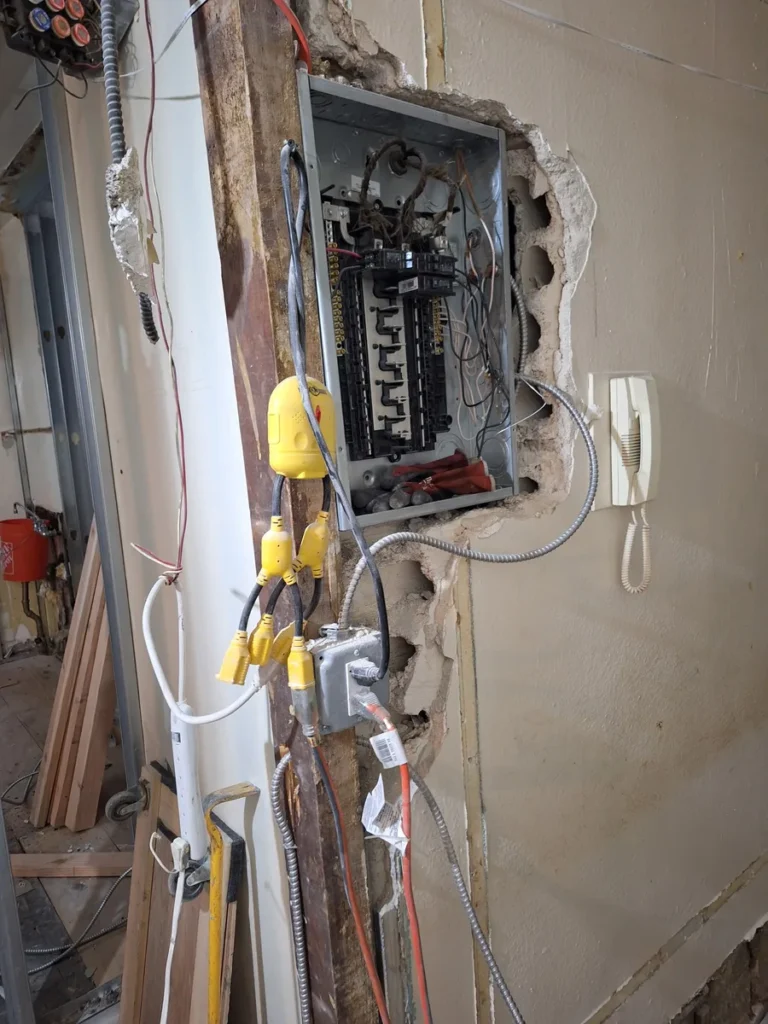
Everything above assumes the circuit is at least intact and correctly protected. In a lot of NYC housing stock, that is an assumption worth checking before December.
- A fuse box instead of breakers. Common in pre-war apartments and unrenovated brownstones. Fuses work, but they invite the worst shortcut in the trade — a blown 15-amp fuse replaced with a 20 or 30, which removes the protection on 14-gauge wire entirely.
- 60-amp service for the whole apartment. Adequate in 1935. Not adequate for a modern kitchen plus winter heating loads.
- One circuit covering several rooms. Very common. It is why plugging a heater into the bedroom trips the hallway light.
- An oversized breaker. If a 20-amp breaker is feeding 14-gauge wire, the wire can be overloaded past its rating with nothing left to stop it. Learning to read your own panel is enough to spot this.
If more than one of those is true, the real conversation is an electrical panel upgrade, not winter tips. As a planning range, a 100-amp service upgrade in NYC typically runs $1,800–$3,000 and a 200-amp upgrade $2,500–$5,500, permits and inspection included; whether you need the larger one comes down to a load calculation, which is what the 100-amp versus 200-amp question really turns on. All of it is estimate-range work — the building, the riser and the distance to the meter decide the rest.
Seven things worth checking before it gets cold
- Every heater’s cord and label. A UL or ETL mark, both tip-over and overheat shut-off, and no cracks, splices or tape anywhere on the cord.
- Three feet of clear floor around each heater — bedding, curtains, laundry, paper. On the floor, never on furniture, never in a bathroom unless the unit is specifically listed for wet locations.
- Outlets you are about to lean on. Warm, buzzing, scorched, or loose-gripping receptacles get replaced before the season, not during it.
- Which breaker is which. Label the panel now, while you have time and light. You will want it during an outage, not after one.
- Smoke and CO alarms. Press every test button, and check the manufacture date on the back — alarms expire. Heating season is precisely when they matter, and the NYC rules on who provides and maintains them are specific.
- Outdoor circuits. Stoop, areaway and holiday lighting all belong on GFCI-protected, weather-resistant receptacles with in-use covers, on outdoor-rated cords — the same standard as any permanent outdoor lighting. Snowmelt and salt get into everything.
- Whether the breaker is already telling you something. A breaker that trips only when the heat comes on is not a faulty breaker. It is a correctly functioning breaker reporting an overloaded circuit.
Winter outages, generators, and carbon monoxide
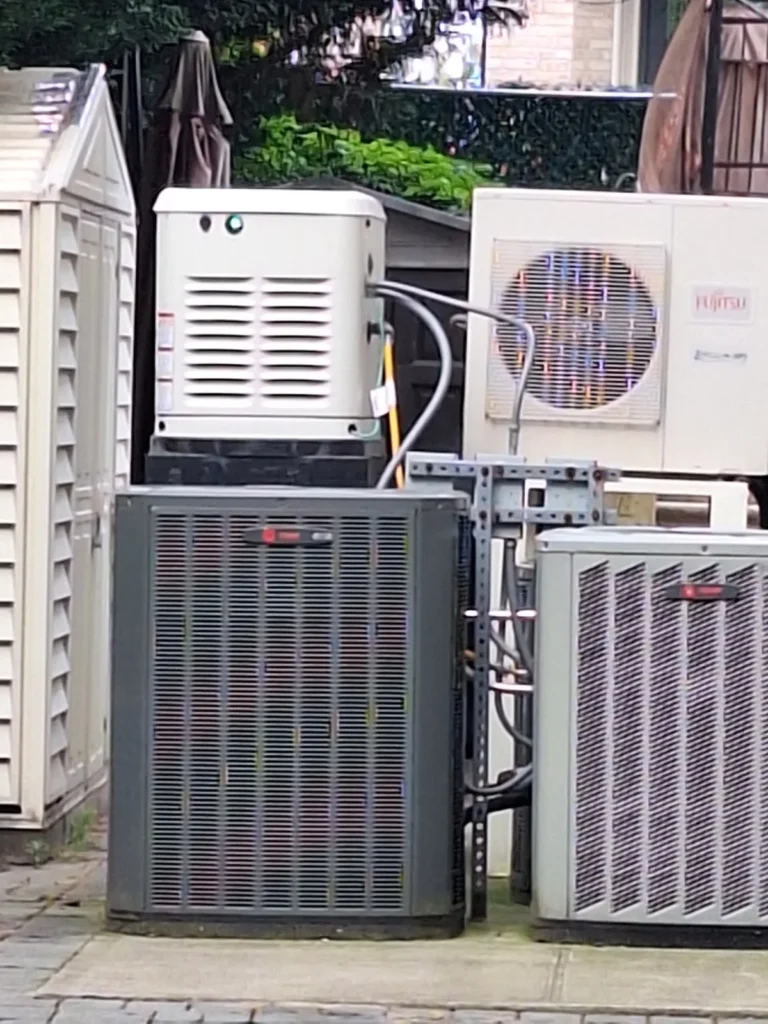
Nor’easters and ice take down NYC power less often than summer heat waves do, but winter outages last longer and cost more, because a building without power in January is also a building without heat. Two rules hold no matter what:
- Never run a portable generator, grill, or camp stove indoors — not in a garage, not in a basement, not near a window or an areaway. Carbon monoxide from a portable generator can reach lethal levels in minutes, and it kills people every winter in exactly these circumstances.
- Never back-feed a generator into a wall outlet. Connecting a generator to house wiring without a transfer switch energizes the service line, which endangers Con Edison crews working to restore your block and can destroy your own equipment when power returns.
If outages are a recurring problem where you live — and in parts of Queens, Staten Island and the flood zones they are — the permanent answer is a permitted, transfer-switched standby generator installation. Much of the preparation overlaps with what we wrote for hurricane season; the checklist does not change much between August and January.
Renters and owners: who is responsible for what
If you rent, heat and hot water are the owner’s obligation, and the enforcement route is 311 — keep your complaints in writing and keep copies. What is yours is how you use the apartment’s electrical system: what you plug in, what you plug it into, and reporting a warm outlet or a burning smell to the landlord promptly and in writing rather than living with it.
If you own — a house, a condo unit, or shares in a co-op — the wiring on your side of the meter is yours, and so is the liability when it fails. Work beyond replacing a fixture needs a licensed electrician and, in most cases, a permit filed with the NYC Department of Buildings; in a co-op or condo the board’s alteration agreement comes first. Unpermitted electrical work is one of the reliable ways to find out, years later, that an insurance claim or a closing has a problem.
When to stop troubleshooting and call someone
Call a licensed NYC electrician the same day for any of these:
- A burning or “hot plastic” smell you cannot trace, or any scorch mark on an outlet or switch
- An outlet, plug, cord or panel that is warm to the touch
- A breaker that will not reset, or that trips immediately with nothing plugged in
- Buzzing, crackling, or arcing sounds from a panel, switch or receptacle
- Lights across the apartment dimming and brightening together — this can indicate a loose neutral, which is a service-level fault, not a circuit problem
If you smell burning and cannot find the source, shut off the affected circuit at the panel first, then call. AE Electric runs emergency electrical service across all five boroughs — and a fifteen-minute look at a panel in October is a much cheaper appointment than an emergency call in January.
Where these rules come from
Heat season dates and temperatures: NYC HPD, Heat and Hot Water. Space heater and cord safety: FDNY, Electrical Home Safety and FDNY’s Top Seven Fire Safety Rules. Licensing and permits for electrical work: NYC Department of Buildings.
AE Electric is a licensed and insured NYC electrical contractor working in Manhattan, Brooklyn, Queens, the Bronx and Staten Island. Panel upgrades, dedicated circuits for heating loads, outlet replacement and emergency service — permitted and inspected. Call (646) 846-0008.
Frequently Asked Questions
Can I plug a space heater into an extension cord or power strip?
No. A space heater plugs directly into a wall receptacle, and nothing else should share that receptacle. The FDNY is explicit about this. The failure point is almost never the copper in the cord - it is a connection: a plug sitting loosely in a worn outlet, or a crimp inside a cheap strip. A loose connection has resistance, resistance at 12.5 amps makes heat, and the heat loosens the connection further.
How many space heaters can I safely run in a NYC apartment?
Think in circuits, not rooms. A 1,500-watt heater draws 12.5 amps, and a 15-amp circuit is designed to carry 12 amps continuously - so one heater on high already uses more than the whole continuous budget of that circuit, before anything else is plugged in. Running a heater on its 750-watt setting (6.25 amps) leaves real headroom. If you need sustained heat in one room, the correct answer is a dedicated circuit sized for it.
My apartment is cold. What is the landlord legally required to do?
Between October 1 and May 31, NYC heat season rules apply: at least 68 degrees indoors between 6 a.m. and 10 p.m. when it is below 55 outside, and at least 62 degrees between 10 p.m. and 6 a.m. regardless of the weather. Hot water must be at least 120 degrees year-round. Ask the landlord or managing agent first, then file a 311 complaint - which can be made anonymously. A space heater is not the remedy for a building that is not meeting this.
Why does my breaker only trip in the winter?
Because a heating load is a continuous load. Summer air conditioners cycle on and off; a space heater runs for hours. The breaker is not defective and it does not need replacing - it is reporting an overloaded circuit accurately. Replacing it with a larger breaker is the dangerous version of this fix, because it lets the existing wire carry more current than it is rated for with nothing left to stop it.
Is a warm outlet or plug actually dangerous?
Yes. After a heater has run for an hour, the plug and the faceplate should be at or near room temperature. Warmth at a connection is the failure itself, not an early warning of one. Stop using that outlet, and have the receptacle and its connections checked. The same goes for any outlet that buzzes, is discolored or scorched, or no longer grips a plug firmly.
Do I need a permit to add a circuit for a heater in NYC?
Yes. Adding a branch circuit is permitted work: a licensed electrician files with the NYC Department of Buildings and the work is inspected and signed off. In a co-op or condo, the board alteration agreement comes before the filing. Expect roughly $300 to $700 for a straightforward dedicated circuit plus the filing fee, more where the run passes through finished pre-war walls. These are estimate ranges - the building decides the rest.