
Most electrical “emergencies” in New York are not emergencies, and a few things people treat as an annoyance genuinely are. The hard part in the moment is not knowing what to do — it is knowing who is responsible for the thing that just broke. Call Con Edison about a problem inside your apartment and you will wait for a truck that has no authority to touch it. Call an electrician about a downed service wire and you have hired someone who is not allowed to work on it either. This guide sorts it out: what to do in the first sixty seconds, and which of the three numbers to dial.
First, the sixty seconds before you call anyone
Whatever the situation turns out to be, these come first, in this order:
- Get people away from it. Not just out of the room — out of contact with anything metal or wet nearby. Water on a floor near a failing outlet is energized in every direction.
- Do not touch a person who is in contact with a live source. You become the second casualty. Kill the power first, or move them with something dry and non-conductive.
- Cut power if you can reach the disconnect safely. The individual breaker if you know which one; the main disconnect if you do not. Safely means: dry hands, dry floor, no smoke coming out of the panel, no buzzing or heat from the panel door. If the panel itself is the problem, do not open it — skip to the call.
- Do not reset a breaker that tripped with a bang, a smell, or a scorch mark. A breaker that trips is doing its job. Forcing it back on removes the only thing standing between a fault and a fire.
- Unplug what you can reach safely, so that whatever failed is not re-energized the moment power comes back.
Then work out which branch you are on. That is the whole decision:
Where Con Edison stops and you begin
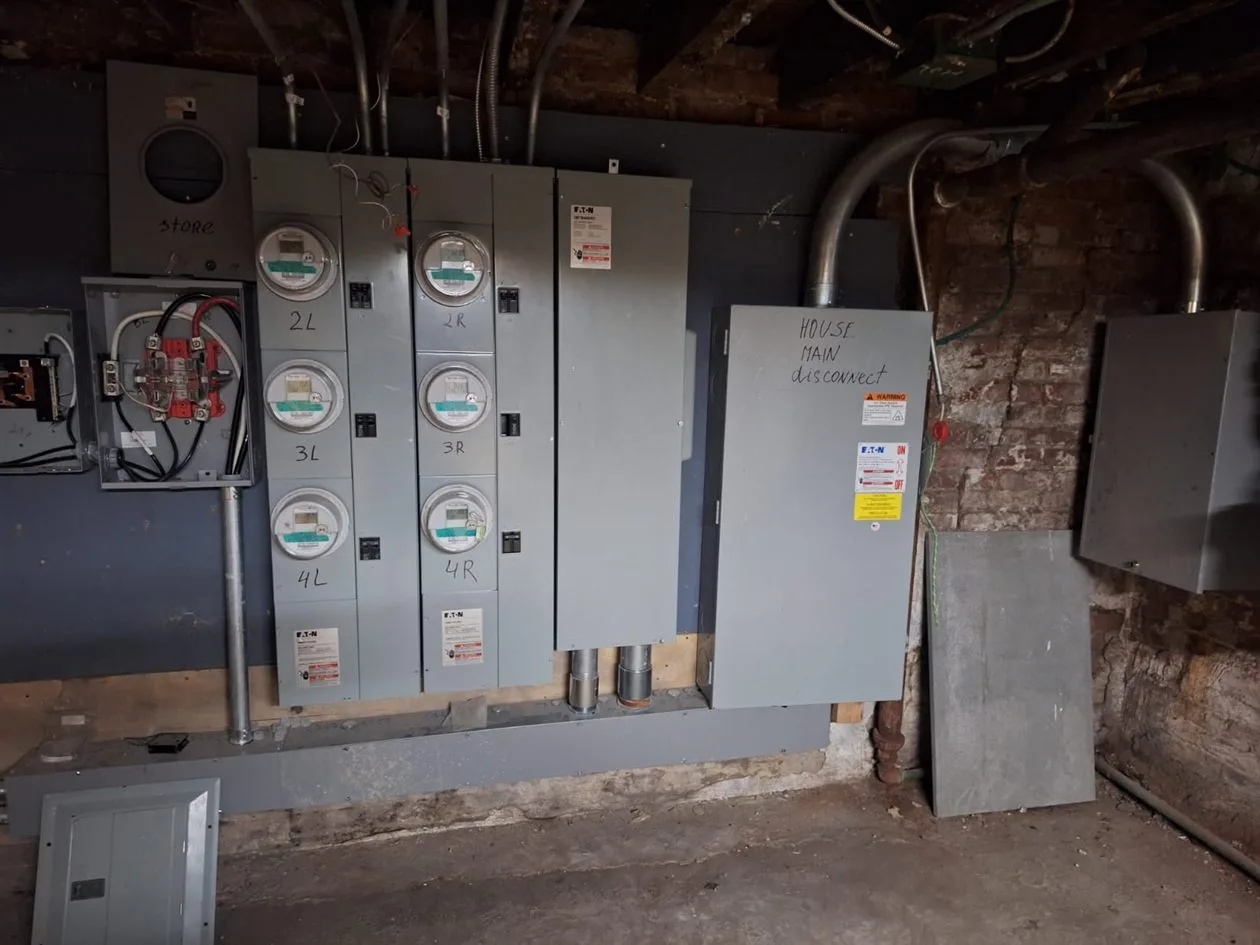
Almost every wrong phone call comes from not knowing where the boundary sits. The short version: Con Edison owns the supply up to and including the meter. Everything downstream of the meter is the property owner’s. The meter is the dividing line, and it is a real, physical thing you can go look at.
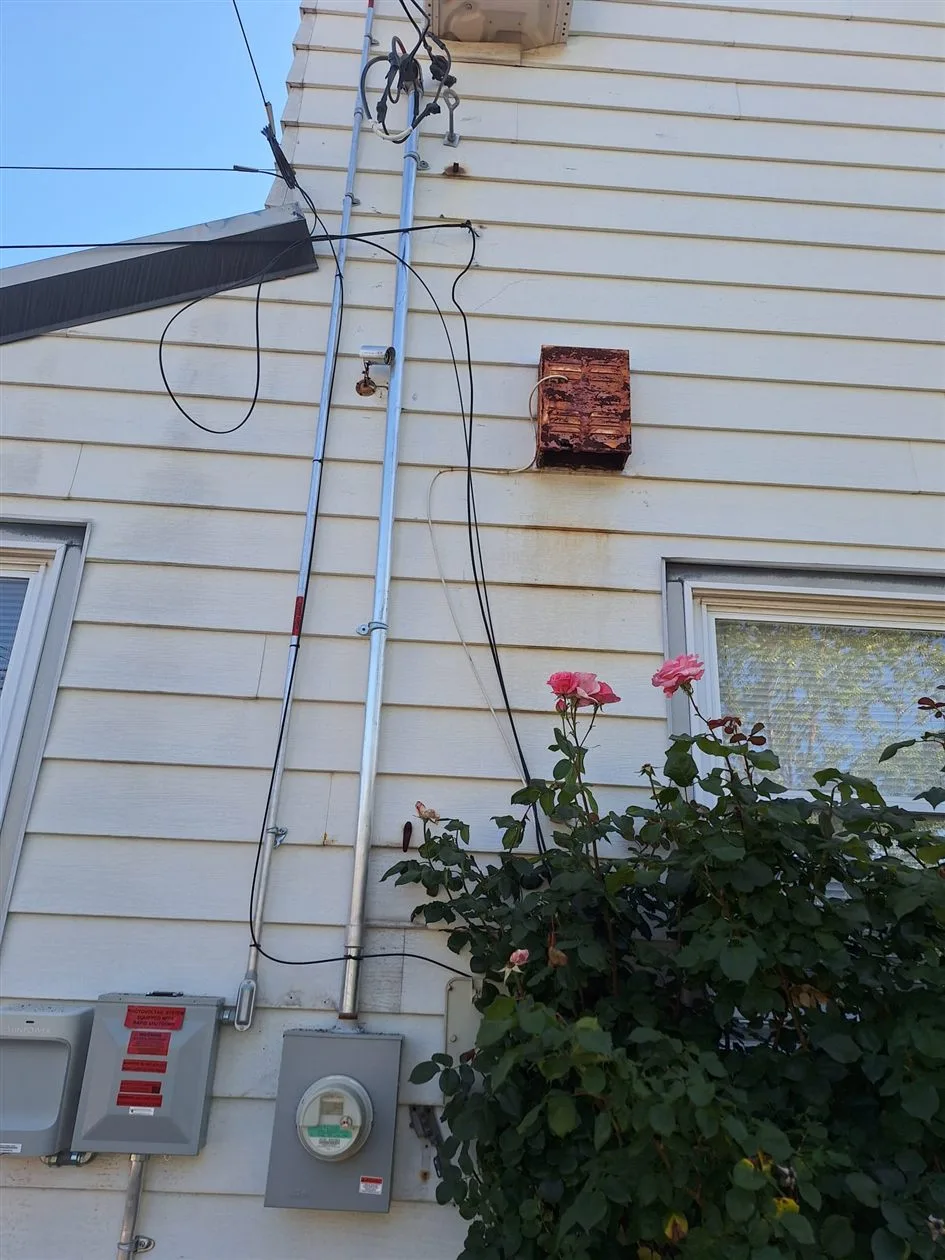
Past the meter you reach the main disconnect and the panel — and from there, every circuit in the building belongs to whoever owns the building. In a multi-family house this gets visually obvious: a bank of utility meters on one side, and the house’s own main disconnect and panels on the other.
Two caveats worth knowing before you argue with a dispatcher. First, on overhead services the mast, weatherhead and service-entrance conductors bolted to the building are frequently the owner’s equipment even though they sit upstream of the meter — so a mast torn off the wall by a falling branch can become a job for both Con Edison (to de-energize and reconnect) and a licensed electrician (to rebuild the mast). Second, Con Edison serves all five boroughs except the Rockaway peninsula in Queens, which is PSEG Long Island. If you are in Far Rockaway or Breezy Point, that is the number to have.
Call 911 first when
- There is any flame, or smoke coming from a wall, ceiling, outlet or panel.
- Someone has been shocked and is unresponsive, confused, burned, or has chest pain — an electrical shock can cause a heart-rhythm problem hours later even when the person feels fine, so it is a hospital question, not a wait-and-see one.
- You smell burning plastic or hot insulation and cannot find the source. An unlocated burning smell is a fire you have not found yet.
- A downed wire is arcing on the street, or has fallen across a car, fence or standing water. Call 911 and Con Edison — FDNY will secure the scene, Con Edison will kill it.
Do not investigate first. Fires inside walls are hidden by definition, and the fifteen minutes you spend confirming it is the fifteen minutes that mattered.
Call Con Edison (1-800-752-6633) when
- A wire is down, hanging low, or arcing. Stay at least 30 feet away, keep others and pets back, and assume it is live and that the ground around it is energized. Never drive over it.
- The whole building or block has no power and your main breaker has not tripped.
- The meter is damaged, burned, sparking, wet or has been hit. Never open, tape, or pull a meter yourself.
- Lights across the entire home dim and surge together, some outlets read low and others read high, or bulbs on one side of the apartment burn out repeatedly while the other side flickers. This pattern is the classic signature of a lost or open neutral on the service, and it is a utility-side fault. It also destroys electronics fast — shut off the main and call, in that order.
- You smell gas at any time, alongside anything electrical. Get out first, then call from outside.
- Flooding is rising toward the meter or service equipment. Con Edison can de-energize the building before water reaches it, which is a far better outcome than after.
The call is free, they run it 24 hours, and reporting a hazard is never a nuisance call. If it is a street condition rather than an emergency — a dark streetlight, an open sidewalk service box that is not sparking — that is 311.
Call a licensed electrician when
Everything past the meter, which is most of what actually goes wrong:
- A breaker trips repeatedly or will not stay reset. Once is a story; three times is a fault. Our guide to why a breaker keeps tripping covers the five usual causes.
- An outlet or switch plate is warm, discolored, scorched, or crackles. Stop using it, kill that circuit, and call. Heat at a device means a loose connection, which is how the majority of residential electrical fires start.
- The panel hums, buzzes, ticks, or smells warm. A panel should be silent.
- You got a shock from an appliance, a faucet, or a metal fixture. That is a grounding or bonding failure, and the next person to touch it may be less lucky.
- Half your apartment is dead but the block is fine and no breaker is tripped — often a failed breaker or a burned connection in the panel.
- Water has reached a panel, outlet, or fixture — from a leak upstairs, a burst pipe, or a flooded basement. Do not energize anything that has been wet until it has been checked.
- Burning smell coming from a specific outlet or fixture you can identify (if you cannot identify it, that is the 911 branch).
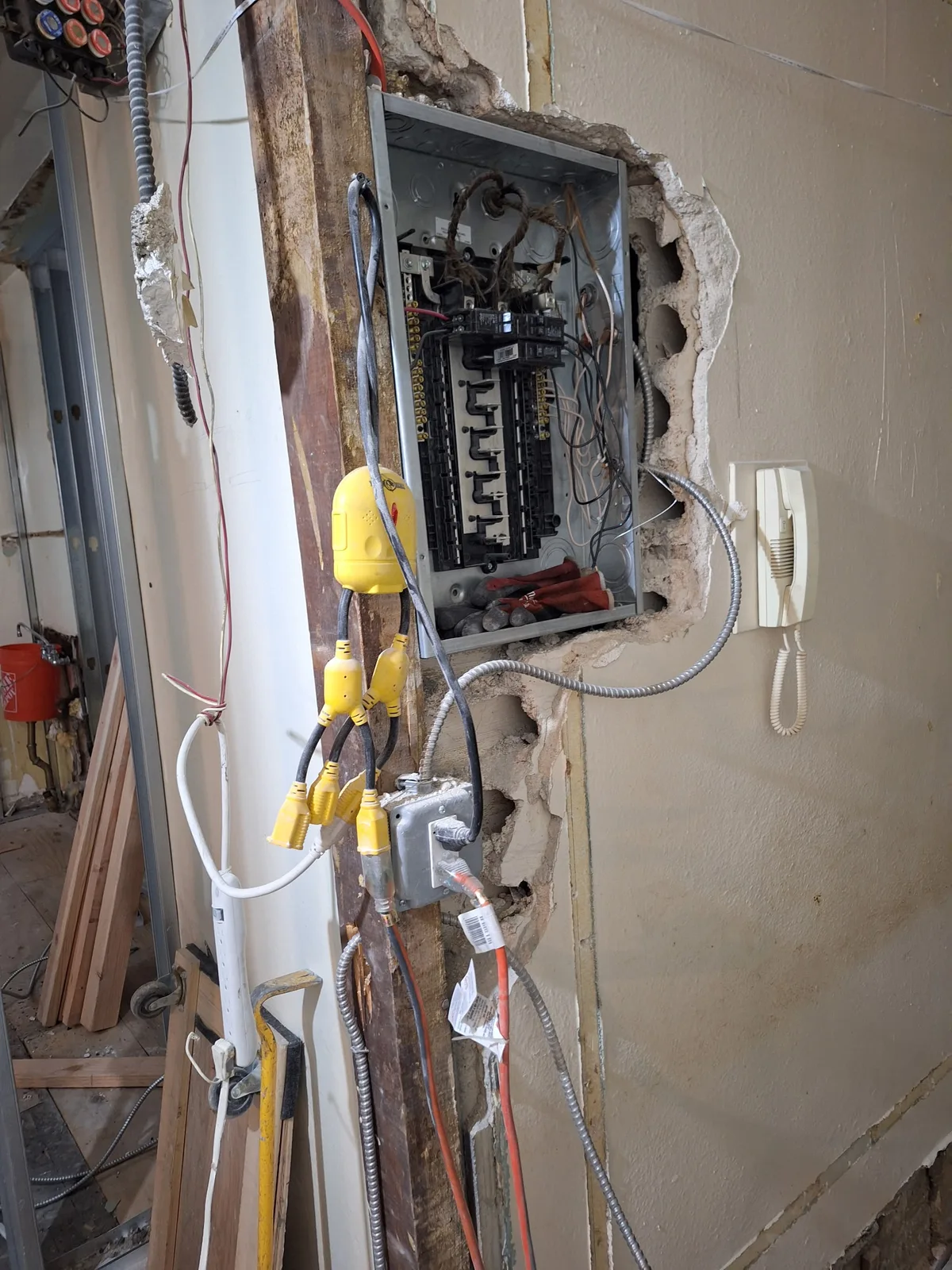
Renting, or in a co-op or condo? Read this first
The branch logic still applies — 911 and Con Edison never wait for anyone’s approval — but the third branch changes shape, because you may not be the person who is allowed to hire the electrician.
- Renters: the electrical system is the landlord’s repair obligation. Notify the super and the managing agent in writing, on the same day, and keep the timestamp. If it is genuinely hazardous and nobody responds, 311 opens an HPD complaint and creates a record.
- Co-op and condo owners: anything from your panel inward is normally yours; risers, the meter room, hallways and shared walls are the building’s. Get the managing agent involved early — work in a shared space usually needs board sign-off and a certificate of insurance from the contractor before anyone can start.
- Everyone: photograph the condition before anything is changed. Insurance and violation questions are settled months later on evidence you either took or did not.
What to expect from an emergency call-out in NYC
An after-hours or same-day electrical call in New York carries a premium over scheduled work, and it typically buys a diagnostic visit plus a make-safe: isolating the fault, killing the affected circuit, and restoring whatever can be restored safely. The full repair — a replacement panel, a new circuit, a permitted rewire — is usually scheduled after, because parts and, where required, a DOB permit are involved. Broader numbers are in our NYC electrician cost guide.
Two things speed up any emergency visit enormously: knowing where your main disconnect is, and being able to say what changed just before it failed — a new air conditioner, a leak upstairs, work done in the building that week. If you are not sure what you are looking at in your own panel, our walkthrough on how to read a NYC electrical panel is worth ten quiet minutes on a normal day.
Cutting down how often this happens
Genuine emergencies rarely arrive without warning. The breaker had been tripping for a month. The outlet had been loose since spring. Three things move the odds meaningfully:
- Label the panel and find the main disconnect now, while nothing is wrong. Tape a card to the panel door with the Con Edison emergency number, your electrician, and the managing agent.
- Treat repeat symptoms as scheduled work. A tripping breaker, a warm plate, a flickering fixture — booked on a Tuesday, these are ordinary jobs. Left alone, they choose their own hour.
- Deal with capacity and surge before the season does. Summer AC load and winter space heaters both find the weakest circuit in the building, an aging panel is the usual bottleneck (see panel upgrades), and Con Edison’s grid delivers enough disturbance that whole-house surge protection pays for itself the first time it works. A periodic electrical safety inspection catches the rest.
Something wrong right now? If it is burning or someone is hurt, call 911. If it is outside your walls, call Con Edison at 1-800-752-6633. If it is inside, past the meter, AE Electric runs same-day and emergency electrical service across all five boroughs — licensed, insured, and permitted where the repair requires it. Call (646) 846-0008.
Related reading: For alarms, see NYC smoke, CO, and gas detector laws. For heating season risks, see winter electrical safety.
Frequently Asked Questions
Do I call Con Edison or an electrician for an electrical emergency in NYC?
The meter is the dividing line. Con Edison is responsible for the supply up to and including the meter, so call them for a downed or arcing wire, a damaged or burning meter, a dark block, or lights dimming and surging across the whole home. Everything past the meter - the main disconnect, the panel, and every circuit, outlet and fixture in the building - belongs to the property owner, and that is a licensed electrician. If anything is burning or someone has been shocked, call 911 first, before either of them.
What is the Con Edison emergency number?
1-800-752-6633 (1-800-75-CONED), staffed 24 hours a day. The call is free and reporting a hazard is never treated as a nuisance. Con Edison serves all five boroughs except the Rockaway peninsula in Queens, which is served by PSEG Long Island. For a non-emergency street condition such as a dark streetlight, use 311 instead.
What should I do first in an electrical emergency?
Get everyone away from the source and out of contact with anything metal or wet. Never touch a person who is still in contact with a live source - kill the power first or move them with something dry and non-conductive. If you can safely reach the breaker or main disconnect, with dry hands and no smoke, buzzing or heat coming from the panel, shut off the power. Then decide whether the call is 911, Con Edison, or an electrician.
Is it safe to reset a tripped circuit breaker?
Once, yes, if nothing else is wrong. Do not reset a breaker that tripped with a bang, a burning smell, or a scorch mark on the panel, and do not reset one repeatedly. A breaker that trips is doing its job, and forcing it back on removes the only protection between a fault and a fire. A breaker that trips three times is reporting a fault that needs to be found.
My lights are dimming and surging across the whole apartment - is that an emergency?
Yes, and it is one of the few that is a Con Edison call rather than an electrician call. Lights that dim and brighten across the entire home at once, outlets reading low on one side and high on the other, or bulbs burning out repeatedly in one part of the home, are the classic signature of a lost or open neutral on the incoming service. It destroys electronics quickly. Shut off the main disconnect if you can do so safely, then call Con Edison.
What do I do about an electrical emergency if I rent my NYC apartment?
The 911 and Con Edison branches never wait for anyone else - make those calls yourself. For anything inside the apartment, the electrical system is the landlord repair obligation: notify the super and managing agent in writing the same day and keep the timestamp. If the condition is genuinely hazardous and nobody responds, calling 311 opens an HPD complaint and creates a record. Photograph the condition before anything is changed.