
Almost every NYC homeowner has stood in front of an open panel door at some point, looking at two columns of black switches and a strip of faded handwriting, trying to work out which one killed the kitchen. A service panel looks cryptic, but it is actually a simple machine, and ten minutes of understanding gives you something genuinely useful: you can find your service size, tell a 120-volt circuit from a 240-volt one, know which breaker feeds what, and recognize the specific signs that your panel is out of room or out of time. Here is how to read yours.
First, find it and open the right door
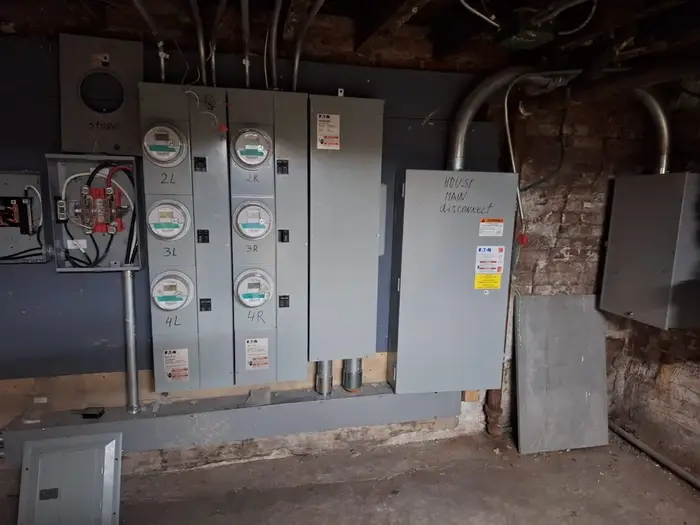
In a NYC house or brownstone, the panel is usually in the basement, near where the Con Edison service and meter come in. In an apartment, it is far more likely to be in a hallway closet, above the refrigerator, behind a kitchen cabinet door, or in the entry foyer. Older buildings sometimes put the apartment panel in a common hallway or a locked meter room, in which case it is the building’s to open, not yours.
There are two covers, and the distinction matters more than anything else in this article. The outer door is the one you swing open to reach the breaker handles, and it is meant to be opened. The deadfront is the metal panel underneath, held on by screws, that covers the live bus bars and every terminal. Do not remove the deadfront. Behind it, the service conductors are energized at full utility voltage even with the main breaker switched off. Everything in this guide is done with the deadfront on.
What is actually inside the box
Power arrives from Con Edison as two 120-volt hot legs plus a neutral. It passes through the main breaker, then onto two vertical bus bars running down the center of the panel. Every branch breaker clips onto one or both of those buses, and that single fact explains nearly everything else you see:
The main breaker tells you your service size
The big switch at the top (occasionally at the bottom, or in the middle on older panels) is the main breaker, and the number stamped on its handle is the most important number in the box. That figure is your service size: the total amperage the whole home can draw at once. In NYC you will typically find:
- 60A — common in pre-war apartments and untouched older houses. Undersized for a modern household; usually a replacement candidate.
- 100A — the long-standing standard, and fine for a modest apartment or a small house without electric heat, a big AC system, or an EV.
- 150A or 200A — what most renovated brownstones and single-family houses are moved to today, and effectively the requirement once you add central air, an induction range, or a car charger.
If your handle reads 60 or 100 and you are planning to add serious load, that number is your real constraint. We walk through the decision in detail in 100-amp vs 200-amp service in NYC.
Single-pole vs double-pole: reading 120V and 240V at a glance
Look at the breaker handles below the main. Most are narrow, single-width switches. A few are twice as wide, or are two handles joined by a bar so they move together. That width is not cosmetic:
- Single-pole (one slot) clips onto one bus, so it delivers 120 volts. These are your 15A and 20A circuits: lights, general outlets, kitchen counter GFCI receptacles, the fridge.
- Double-pole (two slots, joined handles) bridges both buses, so it delivers 240 volts. These are your 30A dryer, 40–50A electric range, central AC condenser, and the 40–60A circuit an EV charger needs.
The number on the handle is the breaker’s amperage rating, which is matched to the wire behind it, not to your appliance. That is why swapping a 15A breaker for a 20A one to stop nuisance tripping is dangerous: the wire in the wall is still 15A wire, and you have just removed the thing protecting it. If a breaker keeps tripping, the cause is on the circuit, not in the breaker size — see why a circuit breaker keeps tripping.
The neutral and ground bars
Along the sides or bottom of the panel you will see one or two metal strips lined with small screws, with white wires and bare copper wires landing on them. Those are the neutral and ground bars. They are not connected to the hot buses; they are the return and safety path. In a main panel the two are typically bonded together, while in a subpanel they must be kept separate — one of the details an inspector checks and a frequent finding in DIY work.
Mapping your circuits, one breaker at a time
The directory card inside most NYC panel doors is either blank, written in the handwriting of an electrician from 1978, or describes rooms that no longer exist. Redoing it takes an hour and pays for itself the first time you need to kill a circuit fast.
- Plug a lamp or a plug-in outlet tester into the first outlet you want to identify, or turn on the room’s lights.
- Switch off one breaker. Note what went dark. Two people with phones makes this dramatically faster than doing it alone.
- Walk the whole floor before switching it back on — one breaker often feeds outlets in two or three rooms in older NYC wiring.
- Write the result in pencil on the directory: room plus what is on it, for example “kitchen counter GFCI + microwave” rather than just “kitchen.”
- Reset any clocks, and re-test GFCI outlets afterward with their test and reset buttons.
Two things worth noting while you do it: if one breaker turns off half your apartment, that circuit is carrying far more than it should, and if you find breakers that feed nothing at all, someone abandoned a circuit without removing it.
What your panel is telling you about its own age
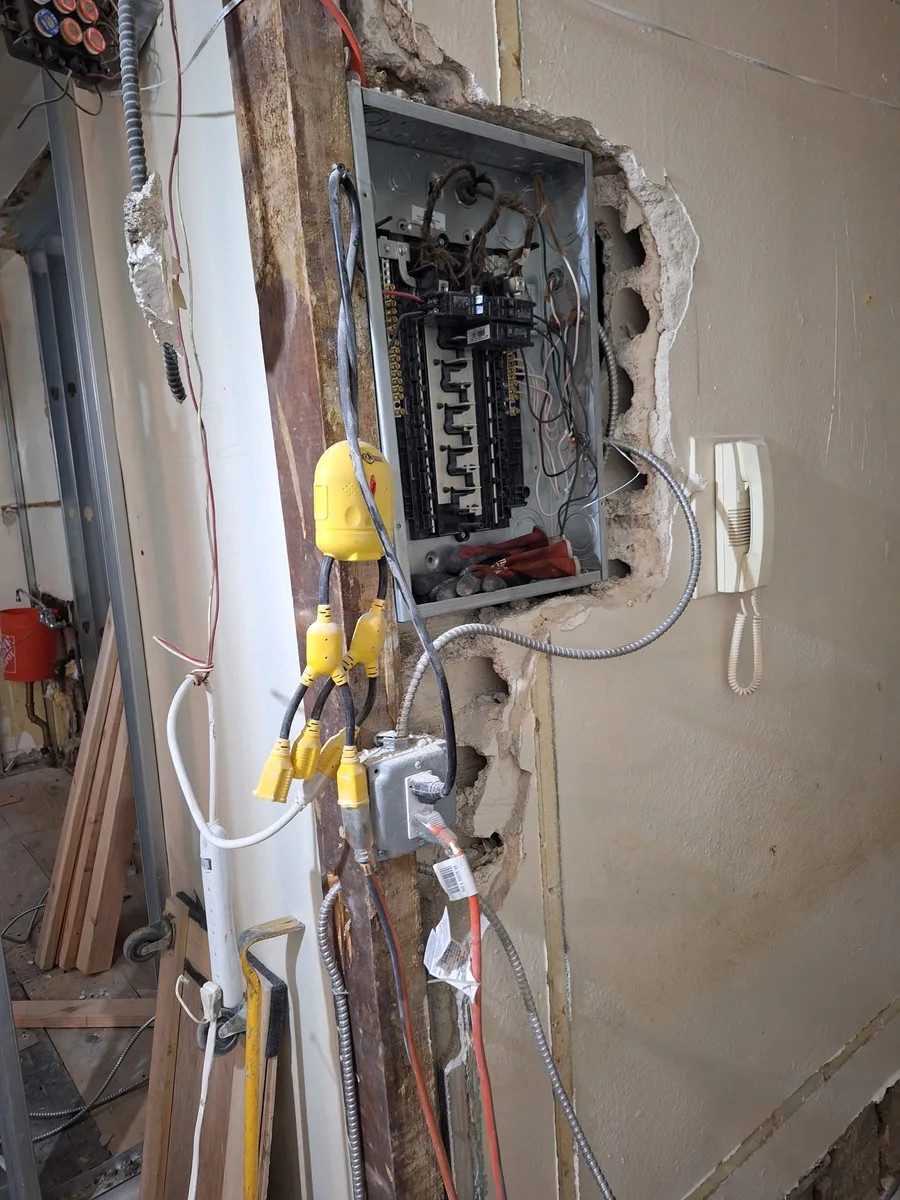
While the door is open, a few things are worth reading off the panel itself:
- Fuses instead of breakers. Screw-in fuses mean the panel predates modern practice entirely and has no room to grow.
- The brand on the door. Federal Pacific, Stab-Lok, or Zinsco are names worth acting on rather than filing away — see why Federal Pacific panels get replaced.
- No spare slots. A full panel means every future addition — AC, an EV charger, a renovated kitchen — starts with a panel job.
- Tandem breakers everywhere. Thin half-width breakers doubled into single slots are a sign someone was already out of room.
- Rust, scorching, a warm cover, or a burning smell. Stop and call an electrician. These are not read-later items.

If several of those apply to you, the full rundown is in 5 signs you need an electrical panel upgrade, and the money side is in our NYC panel upgrade cost guide. Replacement is permitted work: filed with the DOB, done by a licensed electrician, coordinated with Con Edison when the service size changes, and inspected at the end.
Read your panel and did not like what you found? AE Electric assesses, upgrades, and replaces panels across all five boroughs, permitted and inspected — see our electrical panel upgrade service or call (646) 846-0008 for a licensed opinion on what you are looking at.
Frequently Asked Questions
How do I know what amp service my NYC home has?
Read the number stamped on the main breaker handle, the large switch usually at the top of the panel. That figure is your service size: 60A and 100A are common in older NYC apartments and houses, while 150A or 200A is typical after a modern upgrade.
Why are there two columns of breakers in my panel?
Power arrives as two 120-volt hot legs that feed two bus bars running down the center of the panel. Breakers clip onto those buses from both sides. A breaker touching one bus supplies 120 volts, and a double-pole breaker bridging both supplies 240 volts.
Is it safe to open my electrical panel?
Opening the outer door to reach the breaker handles is normal and safe. Removing the inner metal deadfront cover is not. Behind it the service conductors stay energized even with the main breaker off, so that cover comes off only for a licensed electrician.
What does a double-pole breaker do?
A double-pole breaker occupies two slots and bridges both hot buses, delivering 240 volts. It feeds the high-draw equipment in the home: an electric range, a dryer, a central AC condenser, or an EV charger.
Can I put in a bigger breaker to stop one from tripping?
No. The breaker rating is matched to the wire behind it, not to the appliance. Fitting a larger breaker leaves the original wire unprotected and is a fire risk. Repeated tripping means the circuit is overloaded or faulted and needs to be diagnosed.
How do I label the circuits in my panel?
Work one breaker at a time with a second person: switch a breaker off, walk the whole floor to see what lost power, then write both the room and the equipment on the directory card. In older NYC wiring one breaker often feeds several rooms, so check beyond the obvious one.